Equipment
Lowbed vs Flatbed: Choosing the Right Trailer for Oilfield Cargo
Pick the wrong trailer and your cargo is either over height for the route or sitting on a deck that cannot take the load. Here is how lowbeds and flatbeds actually differ — and how to choose the right one for oilfield and project cargo in the UAE.
Approved, cleared & compliant


The core difference: deck height
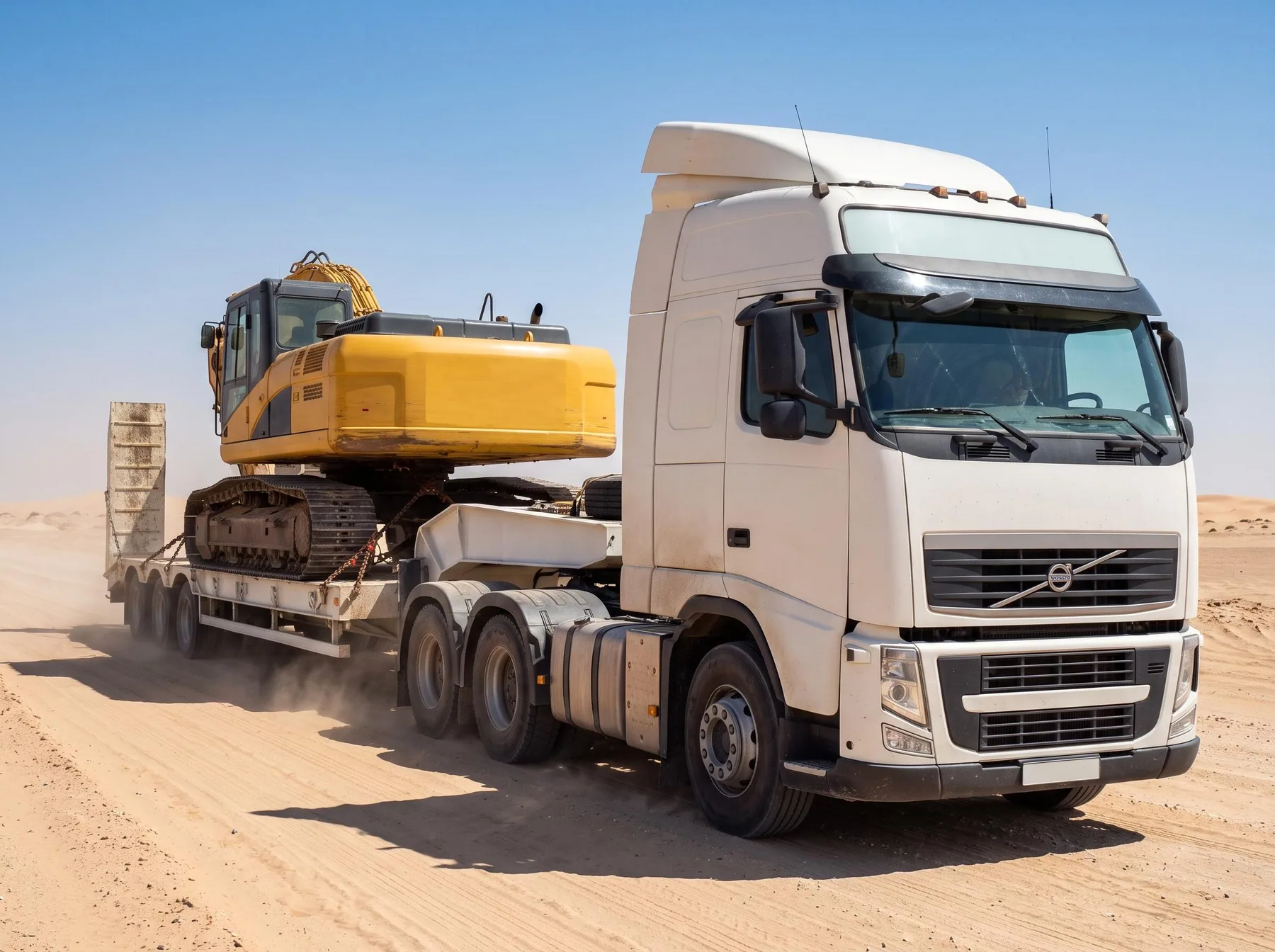
Both trailers carry cargo on an open deck, but they solve different problems. A flatbed is a single, continuous load deck sitting high on the chassis — simple, strong and easy to load from any side or from above by crane. A lowbed (also called a lowboy or float) drops its main deck far closer to the road between a raised gooseneck at the front and the wheel bogie at the rear, creating a low, sunken loading platform.
That dropped deck is the whole point. By starting the cargo lower, a lowbed buys you vertical clearance — so a tall machine that would be illegal or unsafe on a flatbed can travel within height limits on a lowbed. The trade-off is that the flatbed gives you a flat, uninterrupted surface and easier loading for cargo that is heavy but not especially tall.
Tonnage, axles and where each one stops
Capacity is the second decision. Standard flatbeds and step-deck trailers cover a broad band of general freight; lowbeds are built for the heavy and the oversized, with multi-axle and extendable configurations scaling well into project-cargo territory — Decent Way runs lowbed capacity up to 80 tons, with heavier project moves arranged under permit. Match the trailer to the load this way:
- Flatbed — pipe, casing, tubing, drums, palletised materials, steel sections, containers and skid-mounted units within standard height.
- Flatbed strengths — fast side or overhead loading, easy lashing, ideal for long but not tall cargo.
- Lowbed — excavators, dozers, cranes, drilling rigs and substructures, tanks, transformers and tall skids that exceed flatbed height limits.
- Lowbed strengths — low loaded height for clearance, high tonnage on multiple axles, drive-on/off via ramps for tracked and wheeled plant.
- Rule of thumb — if the issue is weight or length, a flatbed often does it; if the issue is height (or it is genuinely heavy and tall), it belongs on a lowbed.
Permits and route surveys for heavy loads
In the UAE, once a load exceeds standard legal limits for weight, width, height or length, it becomes an abnormal (oversize/overweight) load that needs a transport permit and, frequently, a planned route. This is where lowbed jobs differ from routine flatbed runs — the trailer is only half the task; clearing the road is the other half.
- Oversize/overweight transport permits from the relevant UAE traffic and roads authorities before the move.
- Route survey to confirm overhead clearances (bridges, gantries, power lines), turning radii and pavement strength.
- Movement timing and, for larger loads, escort vehicles or pilot cars and approved travel windows.
- For restricted ADNOC sites, the same CICPA driver and vehicle clearances apply on top of the abnormal-load permit.
- Correct lashing, securing and ground-bearing checks at the lift/load point — heavy plant fails most often at loading, not on the highway.
Choosing for a UAE oilfield move
On the Musaffah corridors to Habshan, Bab, Bu Hasa, ASAB, Ruwais and the wider Al Dhafra region, the practical decision usually comes down to a few questions. What is the loaded height once the cargo is on the deck? What does it weigh, and how is the weight distributed? Can it be lifted on by crane, or must it drive on under its own power? And does the destination sit inside a CICPA-controlled zone?
For pipe, casing, steel, drums and skid units within height limits, a flatbed is faster and more economical. For excavators, rigs, tanks, transformers and anything tall or genuinely heavy, the lowbed is the safe and compliant choice — and the one that keeps you within UAE road limits. If you are unsure, send the dimensions and weight and we will spec the trailer, the axle configuration and the permit path for you.
Frequently asked questions
When do I actually need a lowbed instead of a flatbed?
When the cargo would be too tall on a flatbed or is heavy tracked/wheeled plant. A flatbed's deck already sits high, so a machine that is itself tall can breach legal height limits once loaded. A lowbed's dropped deck recovers that clearance and lets heavy equipment drive on via ramps. As a quick test: if loaded height is the binding constraint, or it is an excavator, dozer, crane, rig or large tank/transformer, choose the lowbed.
Who arranges the oversize-load permit and route survey?
Your transporter should. For any abnormal load, Decent Way handles the oversize/overweight permit with the relevant UAE authorities and runs the route survey for overhead clearance, turning and pavement strength — arranging escort vehicles and approved travel windows where needed. You provide accurate dimensions, weight and destination; we manage the permitting and movement plan so the load is legal and safe end to end.
What is the heaviest load Decent Way can move on a lowbed?
Our lowbed capacity runs up to 80 tons, with heavier project moves arranged under permit, with multi-axle and extendable configurations for heavy equipment and project cargo across the Emirates. For loads near the top of that range we confirm the axle setup, securing plan and permit route before mobilising. Send the weight, dimensions and destination to op@decentway.ae or call +971 58 227 4083 for a quote, typically within 2 hours during business hours.