Route guide
Ruwais to Fujairah: Transport Route, CICPA and Non-CICPA Options
Fujairah sits about 447 km by road from Ruwais — the full width of the country, from the western Gulf coast across to the Gulf of Oman. On this lane the distance is rarely what decides the job. Access is: does the run need a CICPA pass at the Ruwais end, and what does the Port of Fujairah require at the other? We operate both variants, CICPA and non-CICPA, for DG and non-DG cargo.
Approved, cleared & compliant


Does a Ruwais to Fujairah run need a CICPA pass?
It depends on where the truck loads, not on where it is going. CICPA — the Critical Infrastructure and Coastal Protection Authority — protects Abu Dhabi's strategic energy assets, and the Ruwais industrial complex sits inside that perimeter. Fujairah does not. So on this lane the pass question is decided entirely at the Ruwais end.
If the collection point is inside the CICPA-controlled complex — a refinery plot, a plant gate, a terminal inside the fence — then the vehicle and the driver both need valid CICPA clearance before they can enter to load, and the cargo movement is logged at the gate. If the collection point sits outside that perimeter, at a yard, a contractor laydown or an open industrial plot, the job is a non-CICPA run and no CICPA pass enters the chain at all.
We run both. Our drivers and vehicles are CICPA-cleared, so a restricted-gate collection is standard work rather than a separate hurdle — and a non-CICPA collection is simply quoted and dispatched without that step. Send us the exact loading point and we will tell you which of the two you are looking at before anything is priced.
- CICPA governs restricted Abu Dhabi energy sites — the Ruwais complex is one of them; Fujairah is not.
- Loading inside the Ruwais perimeter: CICPA clearance required for both driver and vehicle.
- Loading outside it: a non-CICPA run, with no CICPA pass in the chain.
- Both are routine for us — the loading point, not the destination, decides which applies.
Related: What is a CICPA pass? ADNOC field & CICPA transport
Non-CICPA trucks: when the pass is not required
This is the part buyers most often get wrong, and it is worth stating plainly: "non-CICPA" does not mean "no paperwork" — it means a different regime. The phrase is a statement about one authority, not about documentation in general. It tells you the CICPA clearance step drops out of the job. It does not tell you the truck rolls up to the far gate and drives straight in.
The Port of Fujairah operates its own gate-pass regime, entirely separate from CICPA. Access is by pass: annual passes for regular, ongoing work, and short-period passes — daily or weekly — for one-off or campaign deliveries. Security clearance is not applied for by the haulier on its own account; it is processed through the company being visited inside the port, and that company then raises the gate-pass request to the port.
The supporting file is company-level as well as driver-level. Expect a company request letter, the trade licence, and passport, visa and Emirates ID copies for the people entering — and note that the security clearance form itself is completed in Arabic. A separate heavy-vehicle transit permit regime also applies in Fujairah, which is a distinct approval from the port gate pass and needs to be planned as its own item.
So a Ruwais to Fujairah run can genuinely need no CICPA pass at the Ruwais end and still require a Port of Fujairah gate pass at the other. Leaving the second one late is what holds trucks at gates. We work the port-end documentation back through your receiving company before a unit is dispatched.
- Non-CICPA means the CICPA step drops out — it does not mean no documentation.
- Port of Fujairah gate passes: annual for ongoing work, short-period (daily or weekly) for one-off deliveries.
- Security clearance is processed through the company being visited, which raises the gate-pass request to the port.
- Supporting documents: company request letter, trade licence, passport and visa copies, Emirates ID.
- The security clearance form is completed in Arabic.
- A separate heavy-vehicle transit permit regime applies in Fujairah, distinct from the gate pass.
What moves on this lane: flatbed, container and tanker, DG and non-DG
Enquiries on this lane arrive worded very precisely — a trailer for a 10 ft container, twenty 20 ft boxes on normal flatbeds, a pipe lot moving between Fujairah, KEZAD and Ruwais. All of it is standard flatbed and container work, and it splits cleanly into DG and non-DG.
Non-DG is the larger share: steel and pipe, structural sections, packed equipment, project pieces and standard 20 ft and 40 ft containers, which travel on 40–60 ft flatbeds. Smaller 10 ft boxes and multi-unit lots are handled the same way, with the trailer count set by the box size and the number of units.
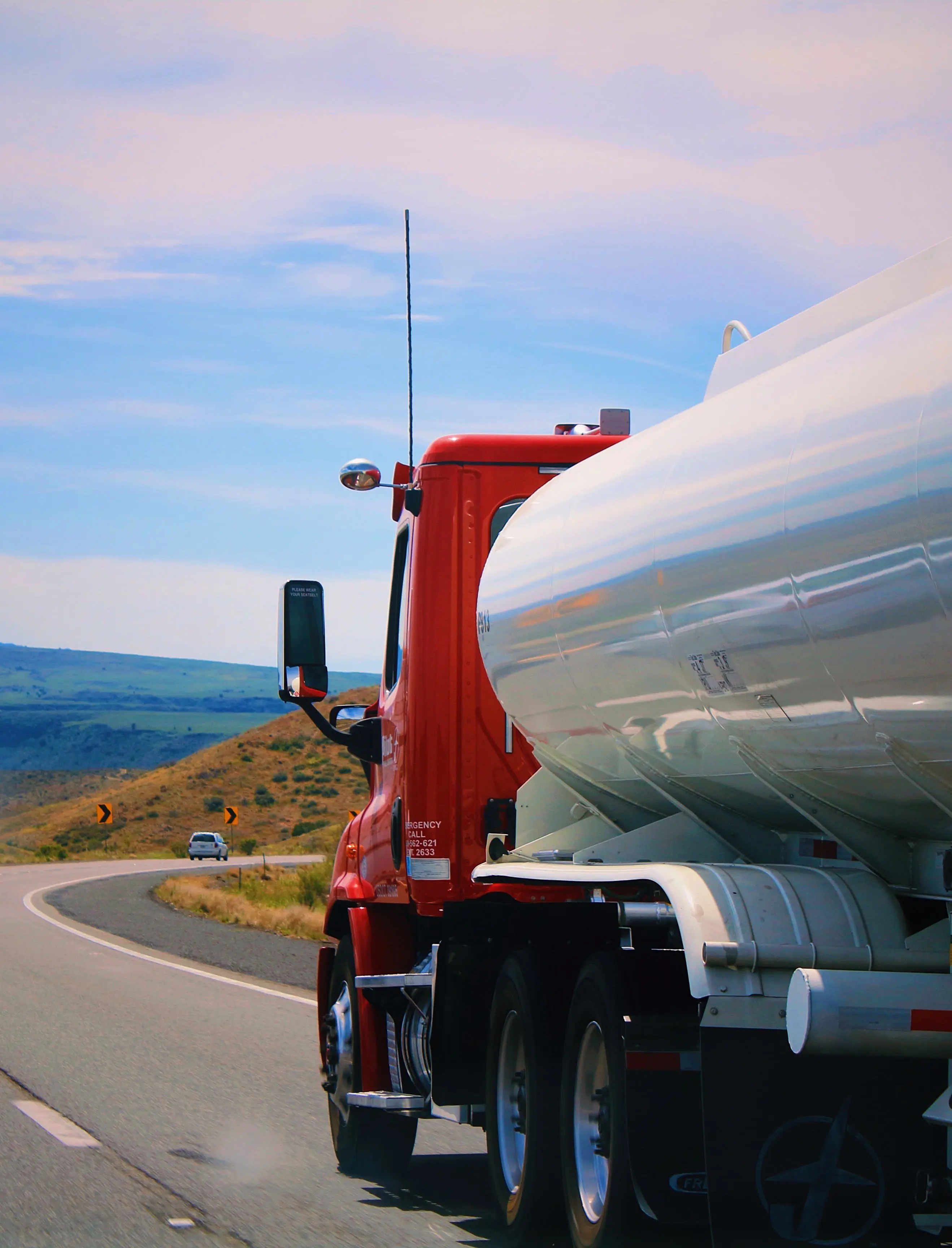
DG is the other half of the lane. Fujairah is one of the world's largest bunkering and oil-storage hubs, and we carry fuels, base oils and petroleum products to and from its terminals, along with chemicals and ADR-classified loads across the eastern emirates, under Civil Defence hazmat permits. Heavier or out-of-gauge pieces move on lowbeds — three-axle units for loads around 40–60 tonnes, four-axle units up to roughly 80 tonnes — with movement permits and escorts arranged where the dimensions call for them.
Tell us the commodity, the weight and dimensions, the container size and count if it is boxed, and whether the cargo is DG or non-DG. That is enough to spec the unit and flag every approval the run will need.
- Non-DG: steel, pipe, structural sections, packed equipment and project cargo on 40–60 ft flatbeds
- Containers: 10 ft, 20 ft and 40 ft boxes on flatbed, including multi-unit lots
- DG: fuels, base oils and petroleum products by tanker to and from the Fujairah terminals
- ADR-classified chemicals under Civil Defence hazmat permits
- Out-of-gauge and heavy pieces on three- and four-axle lowbeds, with permits and escorts where required
Related: Flatbed trailer transport Oil & gas tanker transportation
The route and the Hajar Mountains crossing
Ruwais sits at the far western end of the Abu Dhabi coast; Fujairah is on the Gulf of Oman, on the other side of the country. Between them is about 447 km by road — effectively the full width of the UAE, running east past Abu Dhabi and the northern emirates, then through the Hajar Mountains to the east coast.
Crossing the Hajar Mountains to Fujairah is well within our regular operating range. It is worth understanding what that crossing involves, because it is easy to underestimate from a map. For scale: the Sharjah–Khorfakkan Road, the mountain corridor serving the neighbouring east-coast port of Khorfakkan, runs 89 km with five tunnels driven through the range. Gradients, tunnel clearances and sustained mountain sections are a genuine planning input for a loaded heavy vehicle, not a footnote.
For over-height or over-width loads that matters more than the distance does. Routing, clearances and any permit or escort conditions are set before dispatch, and the final approach — the specific terminal, berth or plot at the Fujairah end — is confirmed with the receiving company in advance, alongside the gate-pass request. That way the unit arrives at a gate that is already expecting it.
- Ruwais to Fujairah: ~447 km by road, coast to coast across the UAE
- The east coast is reached through the Hajar Mountains
- Mountain scale for reference: the Sharjah–Khorfakkan Road runs 89 km with five tunnels
- Over-height and over-width loads get routing, clearances and escort conditions set before dispatch
- The final approach to the terminal or plot is confirmed with the receiving company in advance
Related: Sharjah & Northern Emirates coverage Ruwais site transport
Compliance carried on every trip
The same compliance travels on this lane as on any ADNOC-standard run, whether the job is CICPA or non-CICPA. Our heavy-vehicle drivers are ADSD-certified, every unit in the fleet we operate carries IVMS GPS tracking, and dangerous goods move under Civil Defence hazmat (ADR) permits with correct placarding and approved routing.
That does not change when the CICPA step drops out. A non-CICPA job is not a lower-standard job — it is the same units, the same drivers and the same HSE discipline, with one authority's clearance simply out of scope. What changes is the document set: instead of a CICPA file, the effort goes into the Port of Fujairah gate pass and the Fujairah heavy-vehicle transit permit, worked through the receiving company at the port.
We are an ADNOC-approved transporter based in Musaffah, Abu Dhabi, with a locally based fleet supporting ICV. Send us the loading point, the Fujairah destination, the commodity with its weight and dimensions, and whether the cargo is DG or non-DG, and we will come back with a clear, itemised quote — usually within 2 business hours. Use the quote form, call +971 58 227 4083, or message us on WhatsApp. Operations run 24/7; office and quoting hours are Monday to Friday, 08:00–16:00.
- CICPA clearance for drivers and vehicles, held in advance, where the Ruwais end requires it
- ADSD-certified heavy-vehicle drivers
- IVMS GPS tracking on every unit in the fleet we operate
- Civil Defence hazmat (ADR) permits for DG loads, with the MSDS reviewed before dispatch
- Port-end gate-pass and transit-permit documentation prepared before the truck is dispatched
- ADNOC-approved transporter, Musaffah-based, with a locally based fleet supporting ICV
Frequently asked questions
Does a Ruwais to Fujairah run need a CICPA pass?
Only if the truck loads inside the CICPA-controlled Ruwais industrial complex. CICPA covers restricted energy sites in Abu Dhabi; Fujairah is outside its remit. If the collection point is a yard, laydown or open industrial plot outside the perimeter, it is a non-CICPA run. Send us the exact loading point and we will confirm which applies.
Do you run non-CICPA trucks on this lane?
Yes. We operate both CICPA and non-CICPA trips between Ruwais and Fujairah. Our drivers and vehicles hold CICPA clearance when the restricted gate is involved, and where it is not, the job is quoted and dispatched without that step. Being CICPA-cleared does not restrict us to CICPA work.
If the job is non-CICPA, is there no paperwork at all?
No — non-CICPA means a different regime, not an absent one. The Port of Fujairah runs its own gate-pass system, separate from CICPA, with annual passes and short-period daily or weekly passes. Security clearance is processed through the company being visited, which raises the gate-pass request to the port, and a separate heavy-vehicle transit permit regime applies in Fujairah.
What documents does a Port of Fujairah gate pass need?
The supporting file typically includes a company request letter, the trade licence, and passport, visa and Emirates ID copies for the people entering. The security clearance form itself is completed in Arabic. The request is raised to the port by the company being visited, so we work the file back through your receiving company before dispatch.
Do you carry DG and non-DG cargo to Fujairah?
Both. Non-DG covers steel, pipe, structural sections, packed equipment and 10 ft, 20 ft and 40 ft containers on 40–60 ft flatbeds. DG covers fuels, base oils and petroleum products by tanker to the Fujairah terminals, plus ADR-classified chemicals, run under Civil Defence hazmat permits with certified crews and approved routing. Share the MSDS with any DG request.
How far is Ruwais from Fujairah by road?
About 447 km — effectively the full width of the UAE, from the western Gulf coast across to the Gulf of Oman, with the east coast reached through the Hajar Mountains. For scale on the mountain leg, the nearby Sharjah–Khorfakkan Road runs 89 km with five tunnels driven through the range.