Checklist
How to Choose an Oil & Gas Transport Company in Abu Dhabi: A Buyer’s Checklist
To choose a heavy transport company for oil & gas work in Abu Dhabi, verify five things before price: that they stay accountable for the load end to end, hold current ADNOC approval, run a documented HSE system, carry adequate cargo and liability insurance, and field CICPA-cleared drivers and vehicles with IVMS tracking. A contractor that clears all five can move your cargo to any ADNOC field site legally, safely and on schedule — one that fails any of them puts your load, your permits and your project timeline at risk.
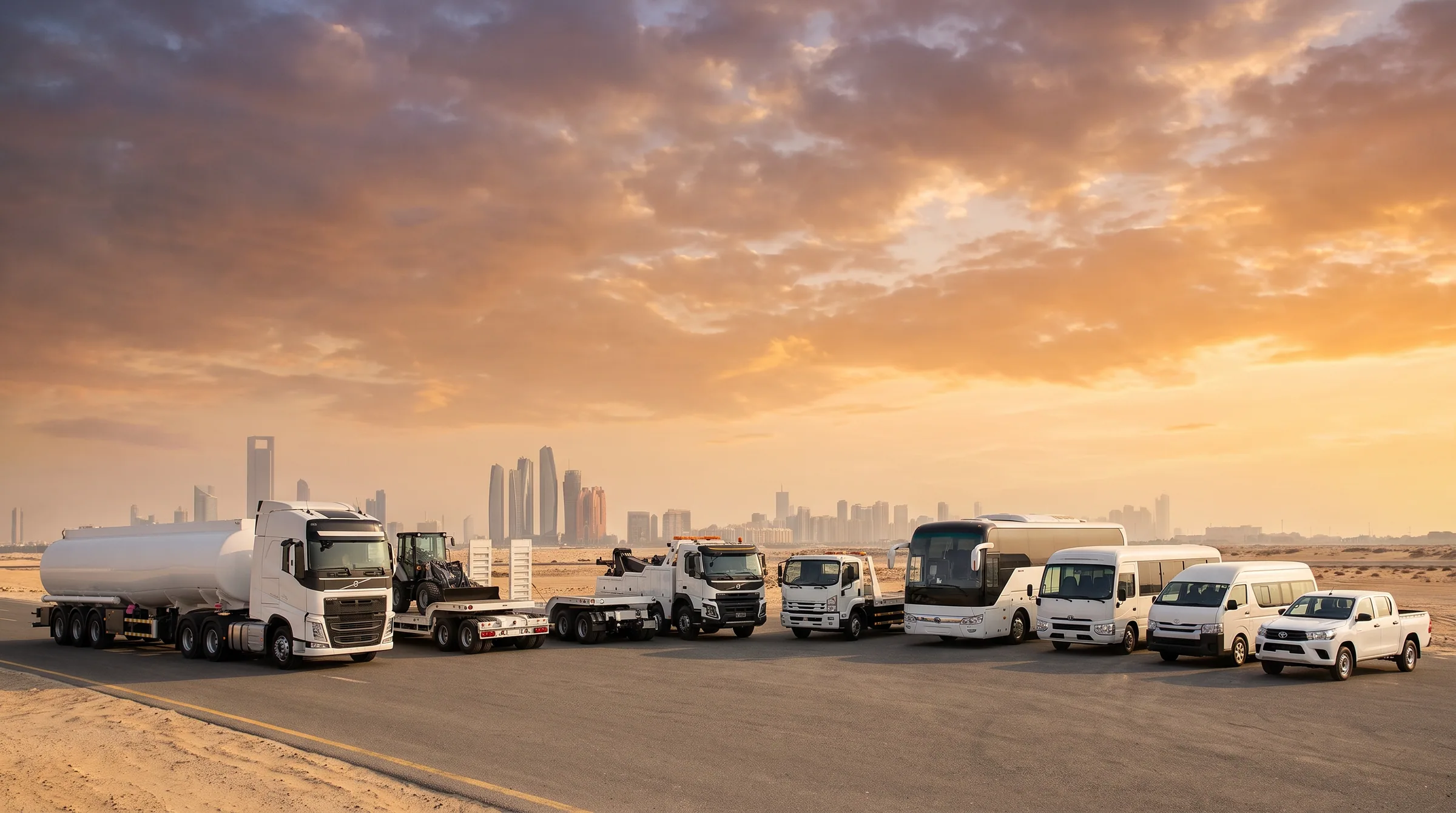
Approved, cleared & compliant

Is one contractor accountable from quote to delivery?
This is the first question, because it shapes everything downstream. You want one contractor that stays accountable for the trucks, the drivers and the maintenance — so it stands behind the timeline, the condition of the equipment and the crew that shows up at your gate, and commits the specific compliant unit in advance rather than an anonymous truck slotted in at the last minute.
For oil & gas work the difference is not academic. When a load has to reach an ADNOC field site with CICPA-cleared drivers, IVMS tracking and hazmat permits, you need to know the exact truck and crew are compliant — named and committed before the job, not swapped in at the gate. Ask directly: which truck and which CICPA-cleared crew will run my load, and who stays accountable if something changes?
- One accountable party — from quote to delivery, with no hand-offs in between
- Named crews — vetted, trained and CICPA-cleared, confirmed in advance
- Committed, compliant units — no unknown truck arriving at the gate
- Warning sign — a contractor that cannot name the exact truck or crew in advance
Is the ADNOC approval real and current?
A genuine ADNOC-approved supplier is registered and in good standing to work on ADNOC group sites — not simply a company that has once carried a load nearby. Approval is the gate to the field: without it, your contractor cannot legally deliver to Habshan, Ruwais, ASAB, Bu Hasa or the other Al Dhafra sites, and a rejected truck at the gate becomes your delay.
Ask to see the supplier registration, and be specific about which entity and which scope it covers. Decent Way is an ADNOC-approved transport supplier operating a locally based fleet that supports clients’ ICV score, with ICV certification in progress. Treat a current ADNOC approval as a hard prerequisite, not a nice-to-have.
Related: ADNOC field & CICPA transport
What HSE evidence should a heavy-haulage contractor show?
A serious contractor runs a documented HSE system to ADNOC HSE standards — not a verbal promise that they are careful. In oil & gas, safety is contractual: the client field expects driver competency records, journey-management plans, vehicle inspection regimes and incident reporting, and it holds the transporter to them.
Ask for the specifics rather than a brochure line. Are the drivers ADSD-certified for heavy vehicles? Are hazmat moves covered by Civil Defence (ADR) permits and Chalwyn-valve-equipped or QCC-compliant units where required? Is there a journey-management process for long Al Dhafra runs done overnight? The answers tell you whether HSE is a system or a slogan.
- Documented HSE system to ADNOC HSE standards
- ADSD-certified heavy-vehicle drivers with competency records
- Civil Defence (ADR) hazmat permits for dangerous-goods loads
- Chalwyn valves / QCC-compliant units where the load requires them
- Journey-management plans for long overnight field runs
Related: Chemical & hazardous cargo transport Dangerous goods transport rules (ADR)
What insurance and liability cover should you confirm?
Confirm the transporter carries valid cargo (goods-in-transit) insurance and third-party liability cover, and ask what each policy actually pays out on. A low quote from an under-insured contractor is a false economy — if a high-value skid or vessel is damaged in transit, the gap between the cover and the loss lands on you.
Request current certificates and check the limits against the value of what you are moving. For dangerous goods and high-value project cargo, the questions get sharper: does the cover extend to hazmat, and to the specific sites and routes involved? Adequate insurance is not the exciting part of vendor selection, but it is the part that protects the project when something goes wrong.
Are the drivers and trucks CICPA-cleared and IVMS-tracked?
For any restricted ADNOC field site, CICPA clearance on both the driver and the vehicle is mandatory — it is the security pass that gets the truck through the gate. If a contractor’s crews are not already cleared, every job becomes a fresh access problem, and an uncleared truck is simply turned away.
IVMS (In-Vehicle Monitoring System) GPS is the other baseline. It lets the field operator and you track the vehicle, verify speed and route compliance, and confirm the load is where it should be. Decent Way runs CICPA-cleared drivers and vehicles with IVMS on every truck, so field access and live tracking are built in rather than arranged case by case.
Related: What is a CICPA pass? IVMS & UAE truck-tracking rules
Does the fleet and coverage match your loads and sites?
Match the contractor’s equipment to your actual loads before you sign. A transporter that only runs flatbeds cannot serve an 80-tonne lowbed move, and one based far from the Al Dhafra fields adds dead-mileage and slower response to every job. Ask what they run and where they routinely operate.
Decent Way operates flatbeds from 40 to 60 ft, three-axle lowbeds around 40–60 t and four-axle lowbeds around 80 t, with heavier 100 t-plus and SPMT-modular moves available by arrangement. From our Musaffah base we run the field routes daily — Al Dabb’iya at 70 km, Mirfa/Hameem at 120, Bab at 140, Habshan at 150, Bu Hasa at 190, ASAB at 210, Ruwais and Jebel Dhanna at 240, Barakah at 250, Shah at 270 and Qusahwira at 330. Operations run 24/7 across day and night shifts, so timing fits the field, not the other way round.
- Flatbeds 40–60 ft for general and project cargo
- Three-axle lowbeds ~40–60 t; four-axle lowbeds ~80 t
- 100 t-plus and SPMT-modular moves by arrangement
- Musaffah base with proven daily Al Dhafra field routes
- 24/7 day and night operations for field-driven scheduling
Related: Lowbed trailer transport for heavy loads Which trailer & how many axles for your load
Your vendor-selection checklist at a glance
Before you compare quotes, run every candidate through the same short checklist. If a contractor cannot clear these points with documents rather than assurances, price is beside the point — the risk sits with your cargo and your project.
Use the list below as your scorecard, then send the shortlisted transporters the same load and site details so the quotes are genuinely comparable.
- Single accountable contractor — one party from quote to delivery, with no hand-offs
- ADNOC approval — current, registered supplier for field-site work
- CICPA clearance — drivers and vehicles already cleared for restricted sites
- HSE system — documented to ADNOC standards, with ADSD-certified drivers
- Hazmat capability — Civil Defence (ADR) permits and compliant units
- Insurance — valid cargo and third-party liability cover with adequate limits
- Tracking — IVMS GPS on every truck
- Fleet fit and coverage — trailers that match your loads and proven field routes
- Response — locally based, 24/7 operations, quotes within 2 business hours
Get a quote and put us on your shortlist
If you are comparing oil & gas transport companies in Abu Dhabi, Decent Way clears every point on the checklist above — an ADNOC-approved fleet with CICPA-cleared crews, IVMS on every truck, ADSD-certified drivers, Civil Defence (ADR) hazmat permits and HSE to ADNOC standards, run 24/7 from our Musaffah base.
Send the cargo weight and dimensions, the pickup and drop-off, the site access (CICPA or open) and the term you want through the quote form, or reach us on +971 58 227 4083 or WhatsApp. We answer quotes within 2 business hours.
Frequently asked questions
What is the most important factor when choosing a heavy transport company in the UAE?
A single accountable contractor backed by the right approvals. One party that holds current ADNOC approval, CICPA clearance and a documented HSE system — and stays responsible from quote to delivery — gives you certainty on compliance, condition and timing. A chain of last-minute hand-offs cannot offer the same.
How do I know if a transporter is really ADNOC-approved?
Ask to see the ADNOC supplier registration and confirm which entity and scope it covers, rather than accepting a verbal claim or a logo on a website. A genuinely approved supplier can deliver legally to ADNOC field sites such as Habshan, Ruwais and ASAB; one that cannot show current registration risks being turned away at the gate.
Why does a single accountable contractor matter?
Because one accountable party means control. A contractor that commits the specific truck and crew in advance can stand behind maintenance, confirm the crew is CICPA-cleared and IVMS-tracked, and keep the same team responsible for your cargo from quote to delivery. When a load changes hands at the last minute, compliance and condition are much harder to verify beforehand.
What insurance should an oil & gas transporter carry?
At minimum, valid cargo (goods-in-transit) insurance and third-party liability cover, with limits that match the value of what you are moving. For dangerous goods and high-value project cargo, confirm the cover extends to hazmat and to the specific sites and routes. Always ask for current certificates rather than a verbal assurance.
Does a locally based transporter really make a difference for field work?
Yes. A transporter based in Musaffah that already runs the Al Dhafra field routes daily responds faster and adds less dead-mileage than one located far away. From our base the field sites range from Al Dabb’iya at 70 km to Qusahwira at 330 km, and a locally based fleet also supports clients’ ICV score, with ICV certification in progress.
How quickly can Decent Way provide a quote?
We answer quotes within 2 business hours during office hours (Sunday to Thursday equivalents, 08:00–16:00), while transport operations themselves run 24/7. Send the cargo weight and dimensions, pickup and drop-off, site access and the term you want through the quote form, or call +971 58 227 4083 or WhatsApp.