Guide
Which Trailer and How Many Axles Does Your Load Need?
The right trailer is decided by four things: how heavy the load is, how tall it is, how long it is, and what shape it is in. Get those four right and the move is legal, safe and priced correctly. Here is how we match a trailer and axle count to a load in the UAE.
Approved, cleared & compliant


Start with weight: it sets the axle count
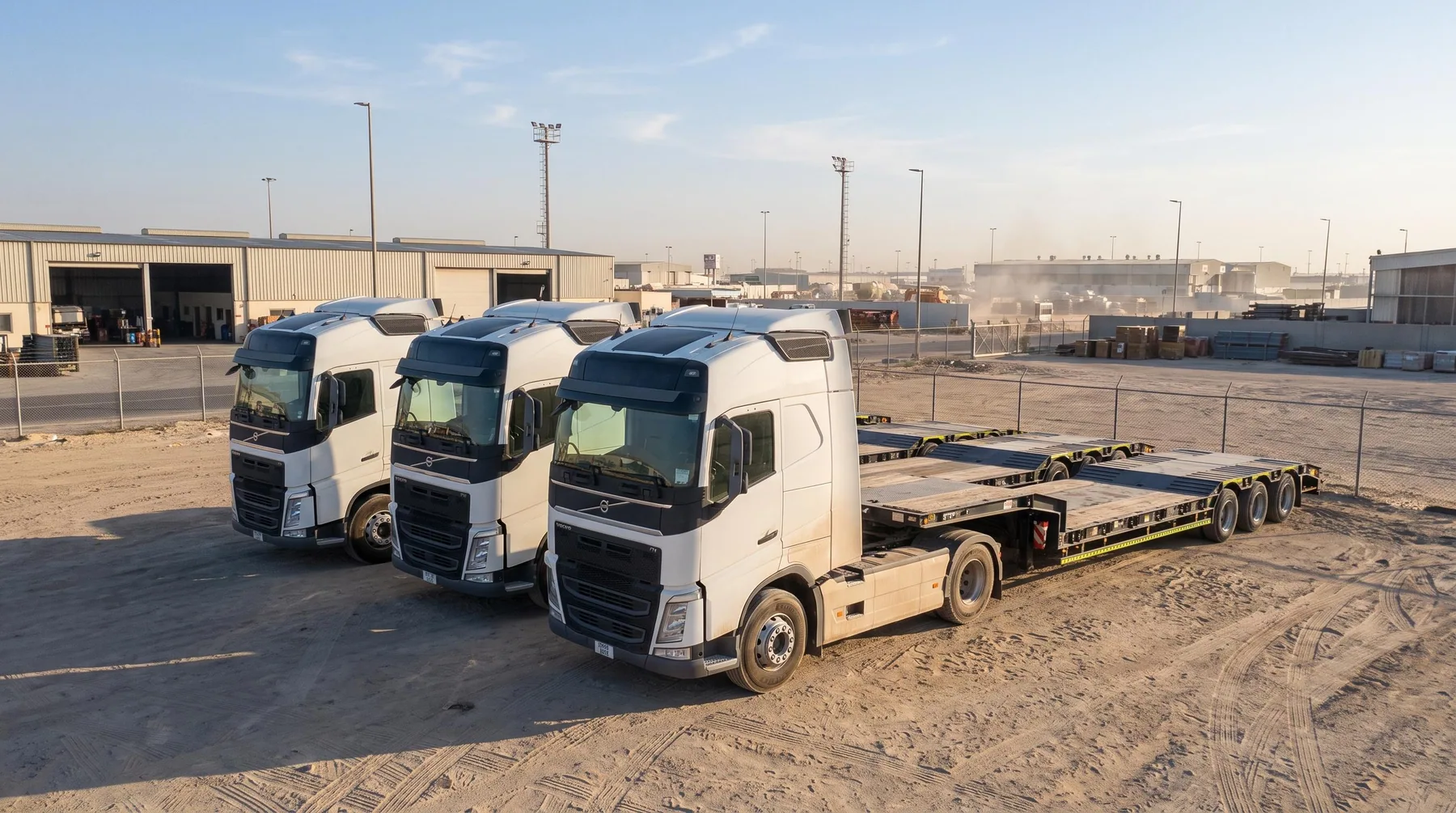
Every axle can legally carry only so much, so the heavier the load, the more axles you need to spread it. As a working guide for UAE roads: a standard flatbed handles general and palletised cargo up to roughly 30–40 tonnes; a three-axle lowbed suits mid-weight machinery; a four-axle lowbed carries heavier plant up to around 80 tonnes; and anything beyond that — 100 tonnes and up — moves on hydraulic modular or SPMT axle lines arranged for the specific unit. The exact figure depends on the load’s footprint and the route’s bridge and axle-load limits, which is why we confirm axle configuration per job.
- Up to ~40 t, not tall — flatbed trailer
- Mid-weight machinery — three-axle lowbed
- Heavy plant up to ~80 t — four-axle lowbed
- 100 t+ or out-of-gauge — modular / SPMT (by arrangement)
Then height: flatbed, lowbed or step-deck
Once the weight fits, check the height. A flatbed sits high, so a tall machine on it can exceed the legal travelling height. A lowbed drops the deck close to the road and buys back that clearance — the usual answer for tall tracked machines, tanks and modules. For loads that are just over height, a step-deck (drop-deck) gives an intermediate lower section without going to a full lowbed. If total height with the trailer is close to the limit, tell us the cargo height and we will pick the deck that keeps you legal.
Length and shape: extendables and skeletals
Very long loads — line pipe, blades, structural steel — may need an extendable trailer that stretches to support the full length rather than letting the load overhang. Shipping containers ride most efficiently on a skeletal (container) trailer that locks to the corner castings, and ISO tanks travel the same way. General palletised and boxed freight sits on a standard flatbed or curtain-side. When you tell us the cargo type, we already know which of these is right.
What we need to quote it
To confirm the trailer, axle count and price in one go, send four things: the weight, the dimensions (length × width × height), the pickup and drop-off points, and whether the site needs CICPA access. With those we can size the trailer, flag any permit or escort needs, and come back with a quote — usually within 2 business hours. Send them through the quote form or call +971 58 227 4083.
Frequently asked questions
How many axles do I need to move 60 tonnes?
A 60-tonne unit typically travels on a four-axle lowbed, though the exact configuration depends on the load’s footprint and the route’s axle-load and bridge limits. Share the weight, dimensions and route and we will confirm the right trailer.
Which trailer carries a shipping container?
A skeletal (container) trailer, which locks to the container’s corner castings, is the most efficient choice for standard and high-cube boxes and ISO tanks. Out-of-gauge or over-height containerised units may move on a flatbed or lowbed instead.
My load is over height — what changes?
Over-height loads move on a lowbed or, for smaller excesses, a step-deck, to keep total travelling height within limits. If it is significantly over, we plan a route survey and any permits or escorts before the move. Tell us the cargo height and we will pick the deck.