Guide
Khalifa Port & KEZAD Logistics: Container Drayage to Musaffah & Industrial Sites
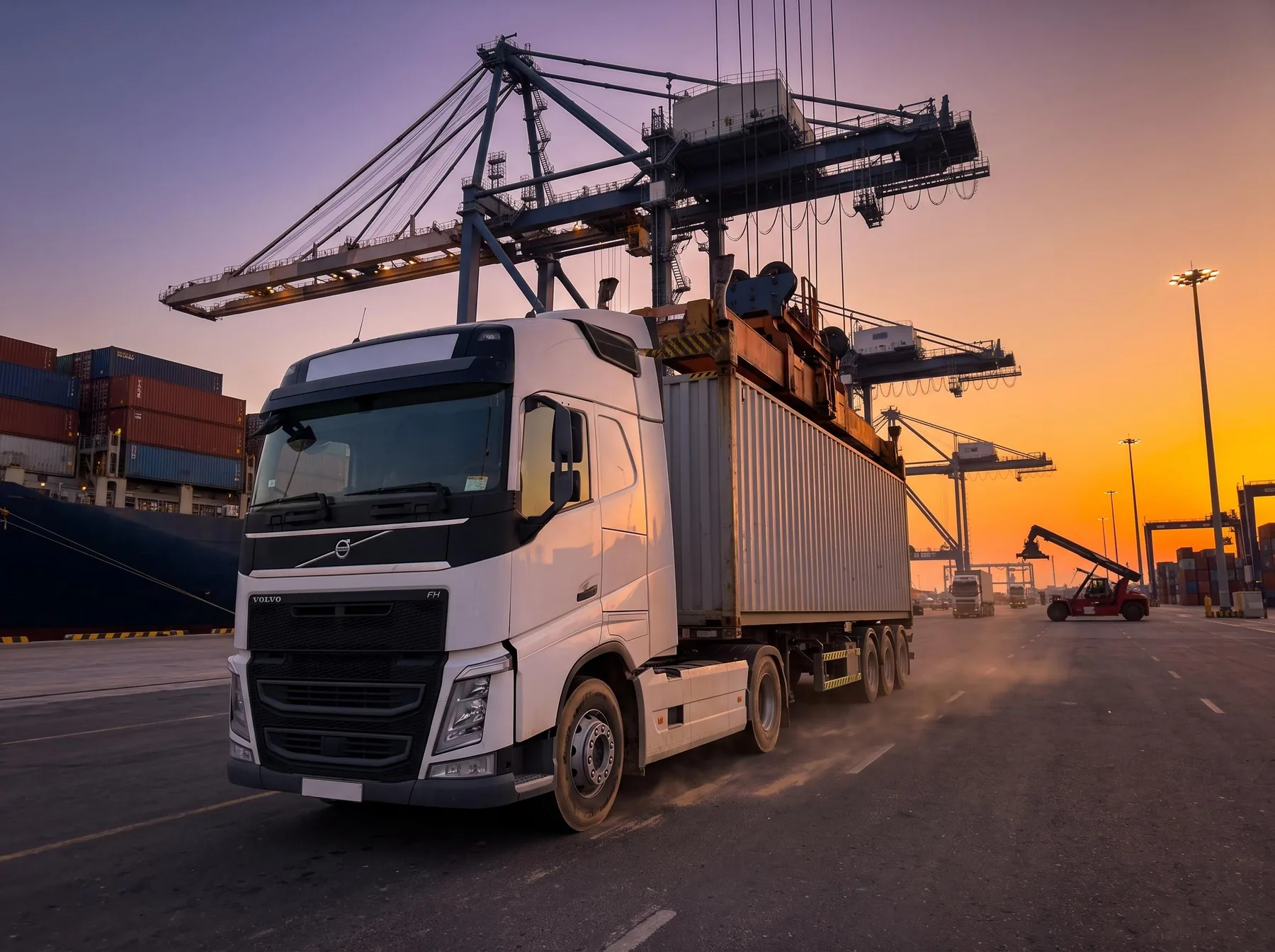
Container transport from Khalifa Port means moving your box from the terminal, through the KEZAD gate network, to a Musaffah yard or an industrial site — a short but document-heavy inland leg governed by the Equipment Interchange Receipt (EIR), terminal cut-off times and gate clearance. Decent Way runs this drayage with CICPA-cleared drivers and IVMS-tracked flatbeds so containers clear the port and reach site on schedule.
Approved, cleared & compliant


Where does container transport from Khalifa Port actually go?
Most containers cleared at Khalifa Port move a short inland leg to a nearby industrial destination — a Musaffah warehouse, an ICAD factory, a KEZAD plot, or a project site deeper in Abu Dhabi. Khalifa Port is the deep-water gateway that sits inside KEZAD (Khalifa Economic Zones Abu Dhabi), so the terminal, the free-zone plots and the customs corridors are part of one connected network.
The drayage leg — the trucking movement between the terminal and the consignee — is short in distance but tight on process. Getting the container off the stack, through the gate and onto the road depends on the release status, the EIR and your appointment window, not just road time.
- Khalifa Port terminal to Musaffah yards — the most common lane
- To ICAD (Industrial City of Abu Dhabi) and KEZAD industrial plots
- To Al Dhafra field sites and project locations by onward haulage
- Empty-return and repositioning moves back to the depot
Related: Khalifa Port operations & logistics Container transport to KEZAD plots
What is an EIR and why does it matter for drayage?
The EIR (Equipment Interchange Receipt) is the document that records a container's condition every time it changes hands — at gate-out from the terminal and again at gate-in on return. It is the single most important piece of paper in container drayage because it establishes who is responsible for any damage and when.
When our driver collects your box, the gate-out EIR notes any pre-existing dents, holes or door damage. When the empty is returned, the gate-in EIR confirms condition again. A clean, correctly-logged EIR chain protects you from being wrongly billed for damage that was already there — which is exactly why we photograph and check the container at every handover.
- Gate-out EIR — logs container condition leaving the terminal
- Gate-in EIR — confirms condition on empty return
- Photo evidence at each handover backs up the paper trail
- A clean EIR chain avoids wrong-party damage and detention disputes
How do terminal cut-offs and gate appointments affect scheduling?
Container moves at Khalifa Port run on appointment windows and cut-off times, not walk-up access. For imports, the box must be released, customs-cleared and have a booked gate slot before a truck can collect it; for exports, the container has to reach the terminal before the vessel's cargo cut-off or it misses the sailing.
Missing a window usually means re-booking a later slot, which cascades into your yard schedule. That is why we align the paperwork — delivery order, customs release and appointment — before dispatching a truck, rather than sending a unit to wait at a closed gate. Fast turnaround also keeps container free-time and detention charges from building up on your account.
Which trailer moves a container — flatbed or lowbed?
Standard dry containers move on flatbed trailers. A 40 ft flatbed carries a single 40 ft box or two 20 ft boxes; our fleet runs flatbeds from 40 to 60 ft with twist-locks to secure the container at the corner castings.
Some cargo needs more than a flatbed. Over-height loads such as open-top containers with a raised cargo, out-of-gauge project pieces, or containers combined with heavy machinery may need a 3-axle or 4-axle lowbed and, in some cases, movement permits. If your box is a standard 20 or 40 ft dry unit, a flatbed is the right and most economical tool; tell us the container type and any over-dimension and we will spec the trailer correctly.
- Flatbed 40–60 ft — standard 20 ft and 40 ft dry containers
- 3-axle lowbed (~40–60 t) — heavier or over-height combinations
- 4-axle lowbed (~80 t) — out-of-gauge and project cargo
- Heavier / 100 t+ / SPMT-modular — available by arrangement
Related: Flatbed trailer transport Lowbed vs flatbed — which to use
Why does CICPA clearance matter for onward haulage to sites?
Many containers do not stop at a Musaffah yard — they carry on to oil and gas field sites where access is controlled. Onward haulage into ADNOC operating areas and other restricted locations requires CICPA-cleared drivers and vehicles, plus gate documentation and, at times, timed entry windows.
Because our drivers and trucks are already CICPA-cleared and our fleet runs to ADNOC HSE standards, that access is built in rather than a separate hurdle. From the Musaffah base the onward distances are known and plannable — Al Dabb'iya 70 km, Mirfa/Hameem 120 km, Bab 140 km, Habshan 150 km, Bu Hasa 190 km, ASAB 210 km, Ruwais 240 km — so a container cleared at Khalifa Port can reach a working site on a scheduled, single-carrier plan.
Related: ADNOC field & CICPA-cleared transport Musaffah to Ruwais heavy transport route
What information gets a container drayage quote fastest?
Container drayage is quoted per job, not off a rate table, because the container type, the destination and the site access all change the effort. A few details let us size the trailer and quote quickly.
Tell us the container size and count (20 ft, 40 ft, high-cube, open-top), whether it is import collection or export delivery, the pickup and drop-off points, and whether the destination is an open yard or a CICPA-restricted site. With that we can flag any permits, confirm the trailer, and turn around a clear, itemised quote — usually within 2 business hours during office hours, while our operations run 24/7.
- Container size and count — 20 ft, 40 ft, high-cube, open-top
- Direction — import collection or export delivery
- Pickup and drop-off points, with the terminal named
- Site access — open yard or CICPA-restricted destination
- Any over-height / over-width or special handling
Request a container drayage quote
Moving a container from Khalifa Port to a Musaffah yard, a KEZAD plot or a field site? Send us the container size and count, the pickup and drop-off, the direction (import or export) and the site access, and we will come back with a clear, itemised quote — usually within 2 business hours. Use the quote form, call +971 58 227 4083, or message us on WhatsApp. Operations run 24/7 for day and night collections.
Frequently asked questions
Is Khalifa Port the same as KEZAD?
They are connected but not the same. Khalifa Port is the deep-water container terminal; KEZAD (Khalifa Economic Zones Abu Dhabi) is the surrounding network of industrial and free-zone areas the port serves. Most containers cleared at the terminal move a short inland leg into KEZAD plots, ICAD or Musaffah yards.
What is an EIR and who handles it?
The EIR (Equipment Interchange Receipt) records a container's condition at gate-out and gate-in, and it is the reference used to settle any damage claim. Our driver receives the gate-out EIR when collecting the box and we photograph the container at handover, so the condition record is clear from the start and you are protected against wrong-party damage charges.
Can you move a container straight to an ADNOC field site?
Yes. Because our drivers and vehicles are CICPA-cleared and our fleet runs to ADNOC HSE standards, we can carry a container from Khalifa Port onward to restricted field sites in a single-carrier plan. Distances from our Musaffah base are known and plannable — for example Bab 140 km, Habshan 150 km, Bu Hasa 190 km, ASAB 210 km and Ruwais 240 km.
What happens if my container misses the terminal cut-off?
Missing a cut-off or gate appointment usually means re-booking a later slot, which can delay your yard schedule and, for exports, risk the sailing. We reduce that risk by aligning the delivery order, customs release and gate appointment before dispatching a truck, so the unit arrives inside its window rather than waiting at a closed gate.
Do you handle both import collection and export delivery?
Yes. We collect import containers from Khalifa Port for delivery to your yard or site, and we deliver export-loaded containers to the terminal ahead of the cargo cut-off. We also handle empty repositioning and return moves, with the EIR chain kept clean at every gate so your account is not exposed to detention or damage disputes.
How quickly can you quote an inland container move?
Usually within 2 business hours during office hours (Monday to Friday, 08:00–16:00). Send the container size and count, the pickup and drop-off, the direction and the site access, and we will size the trailer, flag any permits, and return a clear, itemised quote. Operations themselves run 24/7 for day and night collections.