Guide
How to Transport an Excavator, Dozer or Crane in the UAE
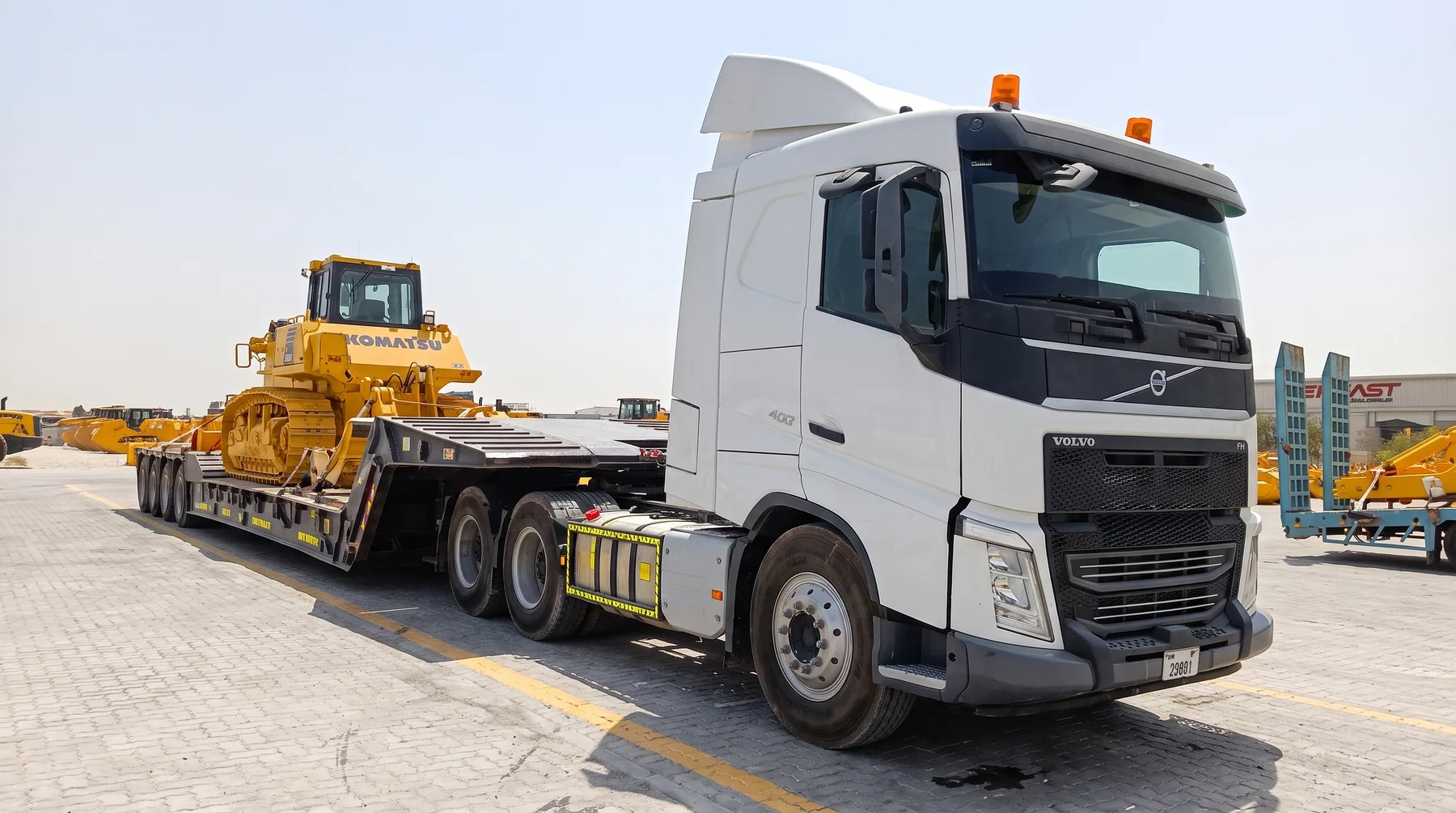
To transport an excavator, dozer or crane in the UAE, match the machine’s weight to the right trailer (a 3-axle lowbed carries roughly 40–60 t, a 4-axle around 80 t), load it by ramp or crane, chain it down at four points, and clear any over-dimension or site-access permits before the move. Doing those four steps in order — trailer, loading, tie-down, permits — is what keeps a heavy-machinery move safe, legal and on schedule.
Approved, cleared & compliant


Which trailer do I need to move an excavator or dozer?
Match the trailer to the machine’s operating weight first — everything else follows from that. Lighter attachments and small plant ride on a flatbed (we run 40–60 ft decks); a mid-size tracked excavator or dozer needs a 3-axle lowbed, rated for roughly 40–60 tonnes; large machines around 80 tonnes call for a 4-axle lowbed. A lowbed’s low deck also drops the loaded height, which is what keeps a tall cab or boom under road-clearance limits.
For anything heavier than that — 100 t-plus modules or machines that need SPMT modular trailers — we arrange the equipment on a project basis. Tell us the make, model and operating weight and we will size the trailer exactly rather than guess.
- Flatbed (40–60 ft) — attachments, small plant, lighter wheeled units
- 3-axle lowbed (~40–60 t) — mid-size excavators, dozers, wheel loaders
- 4-axle lowbed (~80 t) — large excavators and heavy dozers
- 100 t-plus / SPMT modular — by arrangement on a project basis
Related: Lowbed trailer transport Which trailer & how many axles
Should I load by ramp or by crane?
Tracked machines that can drive under their own power — excavators, dozers, drill rigs — are usually loaded up the lowbed’s ramps, walked on slowly and squarely, then repositioned on the deck. Wheeled, non-running or awkwardly balanced units are safer lifted on by crane. The choice depends on the machine’s condition, the ground at both ends, and how much room there is to manoeuvre.
Either way the loading area needs firm, level ground and a clear swing or approach path. Where a lift is involved, we can pair the move with crane and lifting support so the same team handles load-on and load-off.
Related: Crane & lifting services
How do you secure a machine on the trailer?
A machine is chained down at a minimum of four independent points — front and rear — using rated chains and load binders sized to the weight, with the machine positioned to sit within the trailer’s axle-load limits. Correct weight distribution over the axles is as important as the tie-downs themselves; it keeps the rig stable and legal on the road.
Moving parts are then locked or restrained: the excavator boom and bucket lowered and secured, a dozer blade rested down and strapped, a crane’s slew and hook stowed. Tracks or wheels are chocked. On a long run the crew re-checks tension after the first stretch, because chains can settle as the load shifts.
- Minimum four rated tie-down points, front and rear
- Weight distributed within trailer axle-load limits
- Boom, bucket, blade and slew lowered, locked or strapped
- Tracks and wheels chocked; tension re-checked en route
When do I need a permit or an escort?
You need an over-dimension permit whenever the loaded machine exceeds standard legal width, height or length — which many excavators and dozers do once they sit on a trailer. Under UAE regulations, oversize and abnormal loads move on a permit, and larger loads may require a police or pilot-car escort and a defined route and time window. The permit process is why over-dimension moves are planned, not improvised.
We handle the permit and route planning as part of the job, and coordinate escorts where the dimensions or the authority require them. Give us the loaded height, width and length — not just the machine’s catalogue figures — so we flag any permit early rather than at the gate.
Related: Oversize load permits & escorts
How does moving machines to ADNOC or field sites work?
Moves into ADNOC and other secured sites need CICPA-cleared drivers and vehicles, and often gate documentation and timed entry — so site access is planned into the schedule, not left to the day. Because our drivers and trucks are already CICPA-cleared and every truck carries IVMS GPS, that clearance is built in rather than a separate scramble. Our heavy-vehicle drivers are ADSD-certified, and where the machine or its fuel counts as hazardous we run under Civil Defence (ADR) permits.
Distance from our Musaffah base shapes the timing too. As a guide: Mirfa/Hameem is about 120 km, Bab 140, Habshan 150, Bu Hasa 190, ASAB 210, Ruwais and Jebel Dhanna 240, Barakah 250, Shah 270 and Qusahwira 330. We factor drive time, gate clearance and any escort into a realistic window.
- CICPA-cleared drivers and vehicles for ADNOC and secured sites
- IVMS GPS on every truck; ADSD-certified heavy-vehicle drivers
- Civil Defence (ADR) permits where the load is hazardous
- Timing built around drive distance, gate clearance and escorts
Related: ADNOC field & CICPA transport
What should I send you to plan the move?
Five details let us size the trailer, decide loading method and flag permits in one pass: the machine make, model and operating weight; its loaded dimensions (height, width, length on the trailer); whether it runs and drives; the pickup and drop-off points including any CICPA site; and your preferred date or window. Photos help — they show the tracks, attachment and any tie-down points at a glance.
With those in hand we can confirm the right lowbed, plan ramp or crane loading, and pre-empt any over-dimension permit before the truck is dispatched.
- Make, model and operating weight
- Loaded dimensions — height, width, length on the trailer
- Whether the machine runs and drives
- Pickup and drop-off points, including any CICPA site
- Preferred date or time window (photos welcome)
Get your machine moved — quote in 2 business hours
Tell us what you are moving and we will size the trailer, plan the loading and clear the permits. Send the machine make, model and weight, its loaded dimensions, the pickup and drop-off, and your preferred date through the quote form — or call or WhatsApp +971 58 227 4083. We answer quotes within 2 business hours, and our transport crews run day and night, 24/7, across Abu Dhabi and the wider UAE.
Frequently asked questions
What size trailer do I need to transport an excavator?
It depends on the excavator’s operating weight. A mid-size machine of roughly 40–60 tonnes rides on a 3-axle lowbed; a large machine around 80 tonnes needs a 4-axle lowbed; lighter plant and attachments can go on a 40–60 ft flatbed. Machines above 100 tonnes are handled on modular SPMT equipment by arrangement. Send the make, model and weight and we size it exactly.
Do I need a permit to move heavy machinery in the UAE?
If the loaded machine exceeds standard legal width, height or length — which many excavators and dozers do on a trailer — then yes, an over-dimension permit is required under UAE regulations, and larger loads may need an escort and a defined route and time window. We arrange the permit and route planning as part of the move; you just give us the loaded dimensions.
Can you deliver machinery to ADNOC and remote field sites?
Yes. As an ADNOC-approved supplier with CICPA-cleared drivers and vehicles, we deliver to secured and field sites across Al Dhafra — Habshan, Bu Hasa, ASAB, Ruwais, Shah, Qusahwira and more. Every truck carries IVMS GPS, our heavy-vehicle drivers are ADSD-certified, and we run under Civil Defence (ADR) permits where a load is hazardous. Gate clearance and drive distance are planned into the schedule.
How is an excavator secured on a lowbed trailer?
The machine is positioned within the trailer’s axle-load limits and chained down at a minimum of four points with rated chains and load binders. The boom and bucket are lowered and secured, tracks are chocked, and tension is re-checked after the first stretch of the drive because chains can settle as the load shifts. Correct weight distribution over the axles matters as much as the tie-downs.
Should the machine be loaded by ramp or by crane?
Tracked machines that can drive under their own power are usually loaded up the lowbed ramps; wheeled, non-running or awkwardly balanced units are safer lifted on by crane. The right method depends on the machine’s condition and the ground and space at each end. Where a lift is needed we can pair the transport with crane and lifting support so one team handles both ends.
How quickly can you quote a machinery move?
Usually within 2 business hours. Send the machine make, model and weight, its loaded dimensions, the pickup and drop-off points (including any CICPA site) and your preferred date through the quote form, or call or WhatsApp +971 58 227 4083. Our office answers quotes Monday to Friday, 08:00–16:00, while transport crews run 24/7.