Guide
Oversize Load Permits & Escort Rules for Abu Dhabi Heavy Transport
In Abu Dhabi, a load that exceeds standard legal limits for width, height, length or weight needs an abnormal-load (oversize) permit before it moves, and often one or more escort vehicles along an approved route. The permit is issued by the relevant road and police authorities, the route is surveyed in advance, and the timing may be restricted to off-peak or night hours — so oversize moves are planned days ahead, not booked same-day.
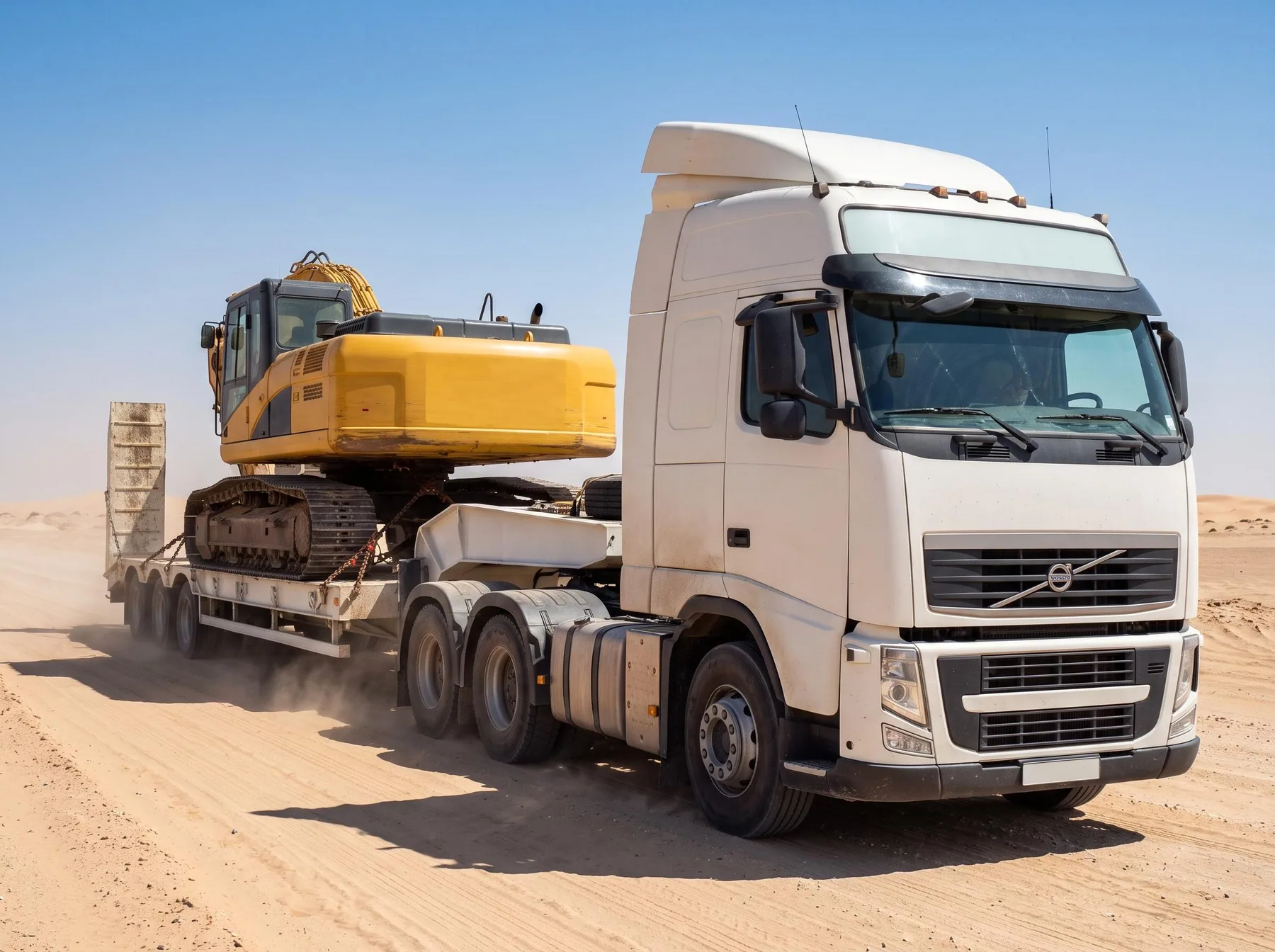
Approved, cleared & compliant


What counts as an oversize load in Abu Dhabi?
A load is oversize (abnormal) once it exceeds the standard legal limits set for vehicles on UAE roads for width, height, length, or axle and gross weight. Under UAE regulations these limits apply to the combined vehicle-and-cargo envelope, so a normal trailer carrying a wide or tall item can still be classed as abnormal even if the trailer itself is legal.
As general regulatory context, ordinary articulated vehicles run up to about 2.6 m wide and roughly 4.2 m high, with length and gross-weight caps set in national rules. Anything beyond those thresholds — a wide skid, a tall vessel, an extra-long structure, or a heavy unit that pushes axle loads over the limit — moves under an abnormal-load permit. We confirm the exact classification against the current authority limits for each job rather than assuming.
- Over-width — cargo wider than the standard legal vehicle width
- Over-height — total loaded height above the standard limit (bridge and overhead-line risk)
- Over-length — long structures overhanging the trailer bed
- Over-weight — gross or axle loads above national caps (needs the right axle configuration)
Related: Which trailer & how many axles for your load Lowbed trailer transport
When do you need an abnormal-load permit?
You need an abnormal-load permit whenever the loaded vehicle exceeds any one of the standard dimension or weight limits — it is triggered by a single threshold, not by all of them at once. The transporter, not the cargo owner, normally applies for and holds the permit, because it is tied to the specific vehicle, axle configuration and route.
The permit names the load, the vehicle, the approved route and the validity window. It travels with the driver and must be produced on demand at checkpoints or gate control. Moving an over-dimension load without a valid permit exposes the operator to penalties under UAE traffic regulations and, on restricted sites, refusal of entry — which is why we secure the paperwork before the wheels turn.
How do escort vehicles and police escort work?
Escort vehicles — pilot cars fitted with warning beacons and signage — travel ahead of or behind the load to warn other traffic and manage lane changes, roundabouts and tight passes. The number and position of escorts depend on how far the load exceeds the limits and on the route; a moderately wide load may need one escort, while a very wide, very long or very tall load can need front and rear escorts.
For the largest or most disruptive moves, the authorities may require a police escort in addition to private pilot cars, and may set the exact timing. Escort requirements are decided together with the permit, so they are known before dispatch rather than improvised on the road.
- Pilot car(s) with beacons and "oversize load" signage — front, rear or both
- Front escort for over-height and over-width to warn of clearances
- Rear escort for over-length overhang on faster roads
- Police escort assigned by the authority for the largest or most disruptive loads
What is a route survey and why does it matter?
A route survey is a planned check of the intended path before the move, confirming that the loaded vehicle can physically and legally pass the whole way. It looks at bridge and overpass clearances for tall loads, road and lane widths and roundabout radii for wide or long loads, weight limits on structures for heavy loads, and obstacles such as overhead power and telecom lines, gantries and street furniture.
For field sites, the survey also covers the last-mile approach and gate access — for example the long runs out to Habshan (about 150 km from our Musaffah base), ASAB (about 210 km) or Ruwais (about 240 km), where the highway is straightforward but the site entrance and internal roads set the real constraints. Where an obstacle cannot be cleared, the survey finds an alternative route or the timing that avoids it, and that approved route is written into the permit.
Related: Musaffah to Habshan & Bab transport route Musaffah to Ruwais heavy transport route
What documents and details do we need from you?
The most important input is accurate cargo dimensions and weight — length, width, height and total weight, plus the centre of gravity and any lifting or lashing points for heavy or awkward units. Under-declared measurements are the single biggest cause of permit delays and rejected gate entries, so it is worth measuring the load as it will actually sit on the trailer, not off a datasheet.
Beyond the measurements, a smooth permit application draws on the pickup and delivery locations, the preferred dates, whether either end is a CICPA-restricted site, and any client or site-specific requirements. With that in hand we size the trailer and axle configuration, apply for the abnormal-load permit, arrange escorts, and lock the route.
- Cargo length, width, height and total weight (as loaded)
- Centre of gravity and lifting / lashing points for heavy units
- Pickup and delivery points, including any CICPA-restricted site
- Preferred dates and any client or site-specific access rules
Related: ADNOC field & CICPA-restricted transport ADNOC restricted-area document checklist
How long does the permit and planning take?
Plan for lead time. Because an oversize move needs a permit, a surveyed route and possibly escorts and a set movement window, it cannot be treated like a same-day flatbed booking. The heavier the over-dimension and the more restricted the route, the earlier it should be scheduled.
We answer quotes within 2 business hours and our operations run 24/7, but the permit and route steps themselves depend on the authorities and the survey findings. The practical rule: send the dimensions and locations as early as you can, so the permit, escorts and any night-window timing are all arranged before your required delivery date rather than compressed against it.
Request an oversize transport plan
Have an over-dimension or over-weight move coming up? Send us the cargo dimensions and weight, the pickup and drop-off points, and your target dates, and we will scope the trailer, the abnormal-load permit, escorts and the route — as an ADNOC-approved transporter with CICPA-cleared drivers and vehicles and IVMS GPS on every truck.
Use the quote form, call +971 58 227 4083, or message us on WhatsApp. We reply within 2 business hours, and operations run day and night.
Frequently asked questions
Who applies for the oversize load permit — us or you?
We do. As the transporter we hold the abnormal-load permit because it is tied to the specific vehicle, axle configuration and approved route. You supply accurate cargo dimensions, weight and the locations; we handle the permit application, escorts and route planning.
Does every wide or tall load need escort vehicles?
Not every one — it depends on how far the load exceeds the limits and on the route. A mildly over-dimension load may move without escorts or with a single pilot car, while very wide, very long or very tall loads can need front and rear escorts, and the largest may need a police escort. The requirement is set together with the permit.
Can an oversize load move at any time of day?
Often not. Wide, long or tall loads are frequently restricted to off-peak or night windows on approved roads to reduce traffic disruption, and the permit may state the allowed movement times. Our operations run 24/7, so a night-window move is not a problem — but the timing is part of what the permit and route survey decide.
What happens if the cargo dimensions were under-declared?
It causes delays and can stop the move. A permit and route are approved against the declared dimensions; if the loaded item turns out larger, the permit may not cover it, escorts may be insufficient, and a restricted-site gate can refuse entry. Measuring the load as it will sit on the trailer avoids re-permitting and a wasted trip.
Do you handle oversize moves to CICPA-restricted field sites?
Yes. Our drivers and vehicles are CICPA-cleared, so access to restricted oil-and-gas sites is built in. For an oversize move the route survey adds the last-mile approach and gate access — for example out to Habshan, ASAB, Bu Hasa or Ruwais — on top of the highway leg, all planned before dispatch.
What if the load is beyond your standard lowbed capacity?
We run flatbeds and 3- and 4-axle lowbeds up to around 80 tonnes as standard. Heavier or 100-tonne-plus units and SPMT/modular transport are handled by arrangement, with the permit, escort and route planning scaled to match. Send the weight and dimensions and we will confirm the right configuration.