Guide
Heavy Vehicle Recovery in Abu Dhabi: Highway & Desert Breakdown Response
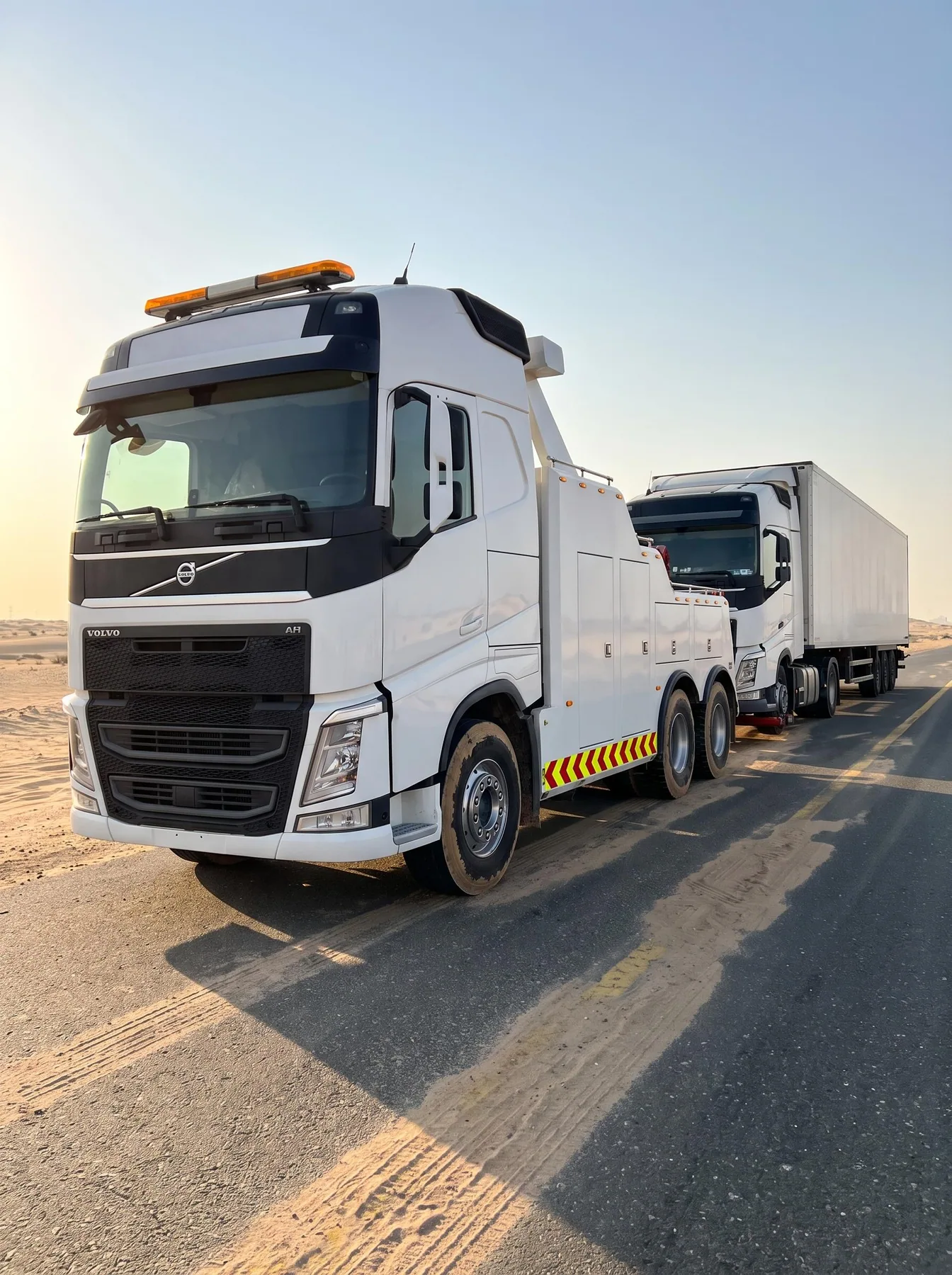
Heavy vehicle recovery in Abu Dhabi is a 24/7 service that recovers stranded trucks, loaded trailers and plant from highways and from soft-sand desert or oilfield sites — using recovery-rated tractor units, lowbeds and winching rather than a consumer tow truck. Decent Way runs recovery day and night from a Musaffah base, with CICPA-cleared drivers and vehicles ready for restricted field sites across Al Dhafra. Call the details through and we dispatch the right unit for the weight, the terrain and the access.
Approved, cleared & compliant

What is heavy vehicle recovery, and how is it different from towing?
Heavy vehicle recovery is the recovery of trucks, prime movers, loaded trailers and mobile plant that have broken down, bogged down or overturned — a job measured in tens of tonnes, not the light towing you would call for a car. It uses recovery-rated tractor units, winches and lowbed trailers to lift or drag the casualty, transfer its load if needed, and carry it to a workshop or safe yard.
For a B2B operator the difference is practical. A consumer tow truck cannot take a 40-tonne laden trailer off a shoulder or pull a stuck excavator out of soft sand. Heavy recovery brings the right axle rating, winching capacity and trained crew, so the vehicle and its cargo are moved without a second incident.
- Casualties handled: prime movers, rigid trucks, loaded flatbeds and lowbeds, mobile plant
- Methods: winching, load transfer, controlled lift onto a lowbed
- Recovery-rated units and trained crews, not a light tow truck
- Cargo secured and moved with the vehicle where it is safe to do so
Related: Lowbed trailer transport Lowbed vs flatbed trailers
Do you respond 24/7, and how fast?
Yes — our field operations run 24/7 across day and night shifts, so a breakdown at 02:00 is dispatched the same way as one at midday. Response time depends on where the casualty is: an incident on the Musaffah–Abu Dhabi corridor is reached far sooner than one deep in Al Dhafra.
To set expectations honestly, distance is the main variable. From our Musaffah base it is roughly 70 km to Al Dabb’iya, 120 km to Mirfa/Hameem, 190 km to Bu Hasa, 210 km to ASAB, 240 km to Ruwais and Jebel Dhanna, and 330 km to Qusahwira. We give you a realistic arrival window when you call, based on the exact location and the unit required. Note that quotes and office coordination are Mon–Fri 08:00–16:00, while emergency recovery dispatch itself is round the clock.
- Al Dabb’iya — ~70 km from Musaffah
- Mirfa / Hameem — ~120 km
- Bu Hasa — ~190 km · ASAB — ~210 km
- Ruwais / Jebel Dhanna — ~240 km
- Qusahwira — ~330 km
Related: Musaffah to Ruwais heavy transport route Al Dhafra region coverage
How does desert and soft-sand recovery work?
Desert recovery starts by stabilising the casualty, then choosing between winching it back onto firm ground or transferring its load before extraction. A truck bogged in soft sand often cannot be pulled straight out under full weight — recovering the cargo first, then the vehicle, protects both the axle and the crew.
On oilfield and remote sites the terrain, the heat and the access rules all shape the plan. We size the recovery unit to the casualty: a 3-axle lowbed for units up to roughly 40–60 tonnes, a 4-axle lowbed for loads to around 80 tonnes, and heavier or SPMT/modular recovery by arrangement. Because our drivers and vehicles are CICPA-cleared, reaching a restricted ADNOC site is built in rather than a separate delay.
Related: Heavy equipment & project cargo transport Which trailer & how many axles
Can you recover from restricted ADNOC and oilfield sites?
Yes. As an ADNOC-approved supplier with CICPA-cleared drivers and vehicles, we can enter restricted field sites where a general recovery contractor would be turned back at the gate. That clearance is the single biggest bottleneck on an oilfield breakdown, and having it in place is often the difference between a same-shift recovery and a wait.
Every truck carries IVMS GPS so its position and status are tracked in transit, and our heavy-vehicle drivers are ADSD-certified. Where the casualty is a hazmat tanker or carries dangerous goods, our ADR-permitted crews and Civil Defence hazmat approvals let the recovery proceed to ADNOC HSE standards rather than stalling on paperwork.
- ADNOC-approved supplier; CICPA-cleared drivers and vehicles
- IVMS GPS tracking on every unit; ADSD-certified heavy-vehicle drivers
- ADR-permitted crews and Civil Defence hazmat approvals for dangerous-goods casualties
- Recovery conducted to ADNOC HSE standards
Related: ADNOC field & CICPA-cleared transport What is a CICPA pass?
What information should you send when you call?
Send four things and we can dispatch the right unit the first time: the exact location, the casualty type, its laden weight, and the terrain and access. Guessing any of these risks sending a unit that is too light or cannot reach the site — which costs you time on a breakdown that is already holding up work.
A dropped pin or coordinates beat a place name, especially in the desert. Tell us whether the vehicle is loaded and roughly how heavy, whether it is on tarmac, a graded track or soft sand, and whether the site needs CICPA clearance or timed gate entry. With that we choose the tractor unit, the lowbed axle count and the winching approach before we roll.
- Exact location — a dropped pin or GPS coordinates, not just a site name
- Casualty type — prime mover, trailer, rigid truck or plant, and whether loaded
- Approximate laden weight — sets the lowbed and axle count
- Terrain and access — tarmac, graded track or soft sand; CICPA or open site
What can go wrong if recovery is done with the wrong equipment?
Under-rated recovery is where second incidents happen. Pulling a laden trailer with a unit that lacks the axle rating or winch capacity can drop the load, damage the chassis, or leave a casualty half-recovered and blocking a live carriageway or field track. On soft sand, forcing a stuck vehicle out under full weight can bury it deeper or overload the drawline.
Doing it properly means matching the unit to the weight, transferring cargo when the numbers call for it, and controlling the lift or drag so the vehicle, the load and the crew all stay safe. That is the practical value of a recovery-rated fleet and trained crews over an improvised pull — the job is closed once, cleanly, to ADNOC HSE standards.
Request heavy recovery
For a heavy recovery in Abu Dhabi — highway, desert or oilfield — reach us any time. Field recovery is dispatched 24/7; send the location, casualty type, laden weight and terrain and we will confirm the unit and a realistic arrival window.
Call or WhatsApp +971 58 227 4083, email op@decentway.ae, or send the details through the quote form. For planned moves and non-urgent enquiries our office answers Mon–Fri 08:00–16:00 and returns quotes within 2 business hours.
Frequently asked questions
Do you handle consumer car towing?
No. Decent Way is a B2B heavy recovery operator — we recover trucks, prime movers, loaded trailers and mobile plant, not passenger cars. If your casualty is a heavy vehicle or plant on a highway, desert track or oilfield site, that is exactly what our recovery-rated units are built for.
Is recovery really available at night?
Yes. Our field operations run 24/7 across day and night shifts, so recovery is dispatched around the clock. Only office coordination and formal quoting keep to Mon–Fri 08:00–16:00; an emergency breakdown at night is handled the same as one in daylight.
How far into Al Dhafra can you recover?
Across the whole region. From our Musaffah base we reach sites such as Al Dabb’iya (~70 km), Mirfa/Hameem (~120 km), Bu Hasa (~190 km), ASAB (~210 km), Ruwais and Jebel Dhanna (~240 km) and Qusahwira (~330 km). Arrival time scales with distance, and we give you a realistic window when you call.
Can you recover a hazmat or fuel tanker?
Yes, where the casualty carries dangerous goods our ADR-permitted crews and Civil Defence hazmat approvals let the recovery proceed safely to ADNOC HSE standards. Tell us the product and tanker status when you call so we assign the right crew and plan the route accordingly.
What size vehicle can you recover?
We size the recovery unit to the casualty: a 3-axle lowbed for loads up to roughly 40–60 tonnes, a 4-axle lowbed for around 80 tonnes, and heavier or SPMT/modular recovery by arrangement. Send the approximate laden weight and we confirm the correct unit before dispatch.
Why do CICPA clearance and ADNOC approval matter for recovery?
Because most oilfield breakdowns sit behind a controlled gate. As an ADNOC-approved supplier with CICPA-cleared drivers and vehicles, we can enter restricted sites directly, where an uncleared contractor would be held at the perimeter. That access is often the difference between a same-shift recovery and a long wait.