Guide
How a Rig Move Works: Drilling Rig & Substructure Transport in the UAE
A drilling rig move is not one truck — it is a planned convoy of flatbeds and lowbeds that carries a dismantled rig, in a set sequence, from one well site to the next. In the UAE a rig move combines trailer selection by load (substructure, mast, drawworks and mud modules), oversize permits and police escorts, and CICPA field access, all sequenced so the rig can be rebuilt in the right order on arrival.
Approved, cleared & compliant


What is a rig move, and why does it need so many trailers?
A rig move is the process of dismantling a drilling rig at one well, transporting it, and rebuilding it at the next — and it needs many trailers because a rig is not a single object but dozens of heavy modules. Once the rig is rigged down, it becomes a set of discrete loads: the substructure and base, the mast (derrick), the drawworks, the mud pumps, mud tanks and shale shakers, the power packs and generators, the pipe racks and tubulars, and the accommodation and control cabins.
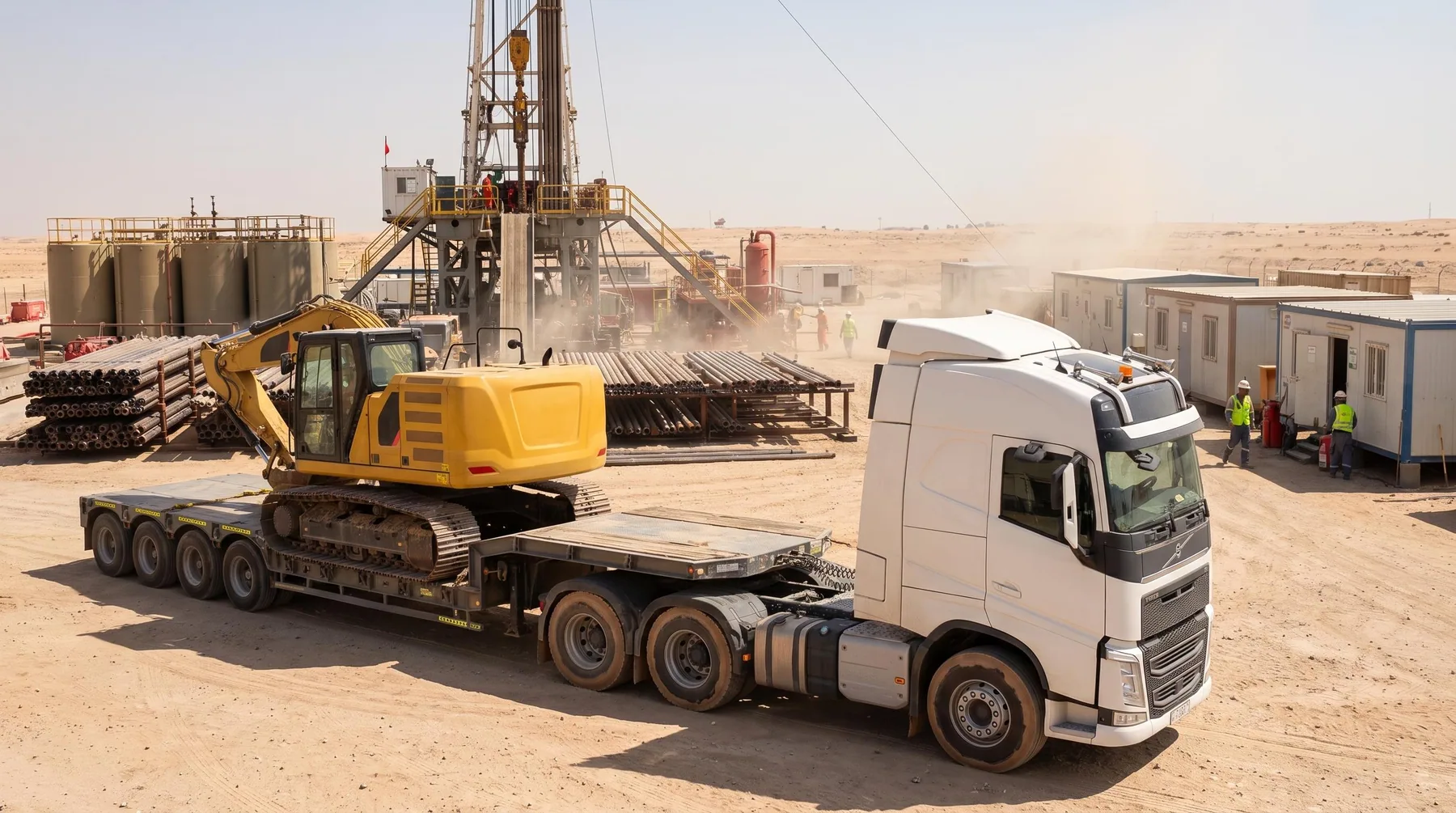
Each of those has a different weight and footprint, so no one trailer suits all of them. A tall, long mast lays down on a flatbed or a stretched combination; a dense drawworks or a loaded mud module needs a low, multi-axle lowbed to keep axle loads legal. A land rig of any size typically takes a convoy of tractor-trailer loads, moved over several trips rather than all at once.
- Substructure and base beams — heavy, compact loads for lowbeds
- Mast / derrick — long and tall, laid down for transport
- Drawworks and rotary equipment — dense, high axle load
- Mud pumps, tanks and shale shakers — bulky modules
- Power packs, generators and fuel — some hazmat-classified
- Pipe racks, tubulars, BOP and accommodation cabins
Related: Heavy equipment & project cargo transport Project cargo & 100t+ module transport
How is the right trailer matched to each rig module?
Each module is matched to a trailer by its weight, length and height, so that axle loads stay legal and the piece sits safely for the road. Long, lighter items — skids, tubulars, pipe racks and the laid-down mast — travel on flatbeds of 40–60 ft. Heavy, dense modules — the substructure, drawworks and loaded mud units — go on 3-axle lowbeds (around 40–60 t) or 4-axle lowbeds (around 80 t), whose low deck keeps the load height down and spreads weight across more axles.
The heaviest single pieces — anything past roughly 100 t, or a load that needs self-propelled modular transporters (SPMT) — are handled by arrangement rather than from our standard fleet. Getting this match right at the planning stage is what keeps a convoy legal, stable and on schedule.
- Flatbeds 40–60 ft — skids, tubulars, pipe racks, laid-down mast
- 3-axle lowbeds (~40–60 t) — substructure sections, mud tanks
- 4-axle lowbeds (~80 t) — drawworks, heavy loaded modules
- 100 t+ / SPMT-modular — by arrangement, planned in advance
Related: Lowbed trailer transport Which trailer & how many axles for your load
Why does the sequence of trailers matter so much?
Sequence matters because a rig is rebuilt in a fixed order, so the last piece off the old site is often the first piece needed on the new one. Loads are therefore dispatched in reverse rig-up order: the substructure and base go first because everything is built on them, followed by the mast and drawworks, then the mud system, power and tubulars, with camp and ancillaries able to follow.
Get the order wrong and a rig-up crew stands idle waiting for a base module stuck three trailers back in the convoy — expensive, since crew and standby equipment are billed by the day. Good rig-move planning treats the trailer schedule as part of the rig-up plan, not a separate transport afterthought, and stages loads so each arrives when the crew is ready for it.
What permits and escorts does an oversize rig load need?
Any load that exceeds standard road limits for width, height, length or weight needs an oversize/overweight movement permit under UAE regulations, and larger loads may require a police or pilot-car escort along an approved route. A wide substructure, a long mast or a heavy drawworks can each trip one of those thresholds, so permits are arranged per piece as part of planning, not left to the driver at the gate.
Some rig modules are also dangerous goods — diesel, mud chemicals and certain fluids — which brings Civil Defence hazmat (ADR) permits, correct placarding and approved-route rules. Our heavy-vehicle drivers are ADSD-certified, and units carrying fuel are equipped and documented to the applicable hazmat standards. Timing matters too: oversize convoys often move on night shifts to avoid traffic, and our operations run 24/7 to suit the escort and permit windows.
- Oversize/overweight permits arranged per piece, not at the gate
- Police or pilot-car escorts for the widest and heaviest loads
- ADR hazmat permits and placarding for fuel and mud chemicals
- ADSD-certified heavy-vehicle drivers; night-shift moves when needed
Related: Oversize load permits & escorts in Abu Dhabi Dangerous goods transport rules (ADR)
How does CICPA field access fit into a rig move?
Most drilling happens inside secured ADNOC oil-and-gas fields, and entry to those fields requires CICPA clearance for both the vehicle and the driver — so a rig move only runs smoothly when every truck in the convoy already holds that access. Our drivers and vehicles are CICPA-cleared and every truck carries IVMS GPS, which means gate entry at fields such as Bab, Bu Hasa, ASAB, Habshan, Shah or Sahil is built into the plan rather than a delay discovered on the day.
Field distance from our Musaffah base shapes the trip and the staging: Bab is about 140 km, Bu Hasa 190 km, ASAB 210 km, Habshan 150 km, Sahil 180 km, and the far Al Dhafra sites like Shah 270 km and Qusahwira 330 km. Knowing the destination early lets us plan escort timing, rest stops and staging so the convoy arrives in the right sequence, cleared to enter.
- Bab ~140 km · Habshan ~150 km · Sahil ~180 km from Musaffah
- Bu Hasa ~190 km · ASAB ~210 km · Bab field cluster
- Far Al Dhafra: Shah ~270 km · Qusahwira ~330 km
- CICPA-cleared trucks and drivers; IVMS GPS on every unit
Related: ADNOC field & CICPA-restricted transport Heavy transport to the Al Dhafra fields
How long does a rig move take, and how is it kept safe?
A rig move runs on the rig-down and rig-up crews as much as on transport, so the transport window is planned around their schedule rather than the other way round. Once modules are rigged down and ready, the convoy shuttles loads over multiple trips; a nearby field may clear in a short campaign, while a far Al Dhafra site involves longer legs, staging points and night runs. We do not quote a fixed duration blind — it depends on rig size, distance and how many trips the fleet runs in parallel.
Safety is handled to ADNOC HSE standards throughout: securing and lashing each load correctly, keeping axle loads legal, using escorts where required, and tracking every truck by IVMS. Drivers are ADSD-certified and CICPA-cleared, and journeys are planned with rest and staging built in so fatigue never rides with an oversize load.
Plan your rig move with Decent Way
Tell us the rig, the sites and the schedule, and we will plan the convoy, trailers, permits and CICPA access around your rig-up sequence. Share the module list with weights and dimensions, the pickup and destination fields, and your rig-down date — and we will come back with a clear, sequenced plan, usually within 2 business hours.
Send it through the quote form, call +971 58 227 4083, or message us on WhatsApp. Our office answers quotes Monday to Friday, 08:00–16:00, while field operations run 24/7 to suit escort and permit windows. For the heaviest single lifts — 100 t+ or SPMT-modular — tell us early so we can arrange the right equipment in advance.
Frequently asked questions
How many trailers does a typical rig move need?
It varies with rig size, but a land drilling rig is a convoy of many tractor-trailer loads, not a single trip. The rig is dismantled into modules — substructure, mast, drawworks, mud system, power and camp — and each rides the trailer that suits its weight and dimensions, moved over several trips in a planned sequence.
Why is the trailer sequence planned in reverse rig-up order?
Because a rig is rebuilt in a fixed order, the pieces needed first at the new site must arrive first. Loads are dispatched in reverse rig-up order — substructure and base ahead of mast, drawworks, mud and tubulars — so the rig-up crew is never left idle waiting for a module stuck further back in the convoy.
Do rig loads need permits and police escorts in the UAE?
Loads that exceed standard limits for width, height, length or weight need an oversize/overweight permit under UAE regulations, and the widest or heaviest pieces may require a police or pilot-car escort on an approved route. Fuel and mud-chemical units also need Civil Defence hazmat (ADR) permits and placarding. We arrange these per piece during planning.
Can you access CICPA-restricted ADNOC fields for rig moves?
Yes. Our drivers and vehicles are CICPA-cleared and every truck carries IVMS GPS, so gate access at secured ADNOC fields such as Bab, Bu Hasa, ASAB, Habshan, Shah and Sahil is built into the plan. We are an ADNOC-approved supplier and work to ADNOC HSE standards throughout the move.
What about the heaviest single rig components?
Standard modules travel on our flatbeds (40–60 ft) and 3- and 4-axle lowbeds (around 40–80 t). The heaviest single pieces — anything beyond roughly 100 t or a load needing SPMT-modular transporters — are handled by arrangement. Tell us early with the exact weight and dimensions so the right equipment is planned in advance.
How far in advance should we book a rig move?
As early as you can share the rig-down date, module list and destination field, because permits, escorts and CICPA-cleared capacity all need scheduling. We return a sequenced plan usually within 2 business hours of receiving the details, and the earlier we plan, the smoother the escort timing, staging and gate access on the day.