Route guide
Khalifa Port to Khorfakkan: Container Transport Route & Lane Guide
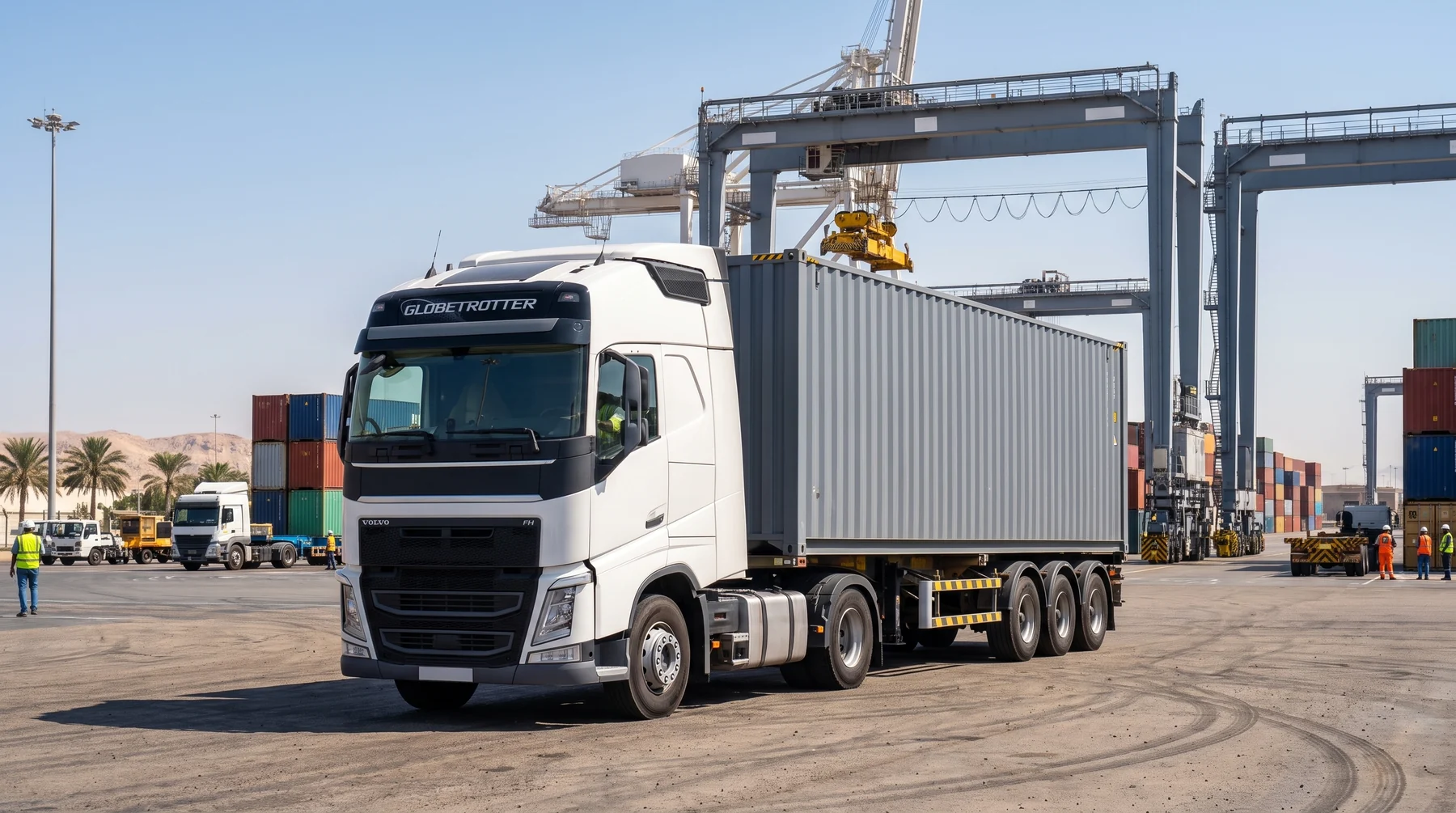
Khorfakkan sits roughly 210 km by road from Khalifa Port at Taweelah — the width of the country, from the Abu Dhabi coast across to the east coast. It is one of the most frequently named port pairs in our inbox, and it usually arrives as a single line: a box count, a size, and two port names. This guide covers how the run is actually put together, what moves on it, and how forwarders and shipping lines book it as standing capacity rather than a one-off.
Approved, cleared & compliant


How a Khalifa Port to Khorfakkan run works
A run on this lane has three distinct parts, and only the middle one is driving. At the Khalifa Port end the box has to be released and gated out with its condition recorded on the interchange receipt. Those mechanics are the same as any Khalifa Port collection and we have set them out in full in our Khalifa Port and KEZAD container logistics guide — there is no need to repeat them here. What is specific to this pair is the consequence: once the unit is through the gate it is committed to a single long leg, so the release has to be clean before a truck is dispatched, not sorted out afterwards.
From Taweelah the lane runs up the coastal corridor and then turns inland to cross the Hajar Mountains to the east coast — roughly 210 km in total. The mountain crossing is the defining stretch. The Sharjah–Khorfakkan Road runs 89 km through the Hajar range and passes through five tunnels. For a loaded container unit it is a straightforward road, but it is a committed one: there is no convenient place to turn a laden trailer around halfway.
The Khorfakkan end is a second working container terminal, not a warehouse drop. It has its own gate and its own formalities, so the booking reference, the delivery details and the container documentation all have to line up before arrival — exactly as they did at the Khalifa Port end. Planning the run means planning two gates, not one.
- Collection at Khalifa Port — release, gate-out and container condition recorded
- Road leg of about 210 km, Abu Dhabi coast across to the east coast
- Hajar Mountains crossing on the Sharjah–Khorfakkan Road — 89 km, five tunnels
- Delivery into a working container terminal with its own gate formalities
- IVMS GPS tracking on the unit for the whole leg
Related: Khalifa Port & KEZAD container logistics — EIR and gate process Port & container handling
Container sizes and trailers on this lane
The full range moves on this lane. Standard 20 ft and 40 ft dry boxes are the bulk of it, riding on skeletal trailers or on flatbeds with twist-locks at the corner castings where the collection or delivery point suits a flat deck. High-cube units are routine. Flat-racks and open-tops come up whenever the cargo will not sit inside a closed box, and ISO tanks move on the lane as well.
10 ft containers deserve a specific mention, because they are asked for far more often than most lane lists suggest and they are easy to get wrong. A 10 ft box is short, so the securing plan matters as much as the trailer choice: the unit has to be locked at its own corner castings and positioned on the deck so the load sits correctly rather than simply placed on a long trailer. Tell us the count when you enquire — 10 ft units are usually moved in multiples, and the number is what decides whether they consolidate onto one deck or need separate runs.
Which deck a given box rides on is a general question rather than a lane question, and we have already answered it elsewhere: the flatbed-versus-lowbed decision and the axle count for out-of-gauge pieces are set out in our trailer guides. For this pair the practical rule is that a standard box is a standard job. It is the out-of-gauge, over-height and tank units that need to be flagged at booking, because those change the securing plan and, in some cases, bring permits into the picture.
- 10 ft, 20 ft and 40 ft boxes, including high-cube
- Flat-rack and open-top for cargo that will not sit in a closed box
- ISO tanks and tank containers
- Skeletal trailers, or flatbeds with twist-locks at the corner castings
- Out-of-gauge and over-height units — flag these at booking
Related: Lowbed vs flatbed — which to use Which trailer & how many axles Flatbed trailer transport
Cut-offs, diversions and same-day re-planning
How terminal cut-offs and gate appointments work is the same everywhere, and we have explained the mechanics in full on the Khalifa Port and KEZAD guide. What is different about this pair is simply that there are two of them. The lane joins two working container terminals, so every run is bracketed by a window at each end, and a change at either end reshapes the whole plan rather than half of it.
Vessel movements are the usual trigger. A box booked to sail from one terminal gets re-routed to the other; a berthing slips and the receiving window moves with it; a feeder schedule shifts and the collection has to follow. Because the leg is long and committed, we would rather re-plan than dispatch a unit into a window that has already closed. Our operations run day and night shifts, so when a terminal changes a cut-off or a vessel is diverted we re-plan the run the same day: a unit already loaded can be held, re-timed or re-routed instead of standing at a gate that will not take it.
What helps most from your side is early notice and a single point of contact at the terminal end. Every trip is dispatched and tracked through our booking system, so a re-plan starts from a known position and a known status rather than a phone call trying to establish where the truck actually is.
- Two terminals, two windows — a change at either end re-times the whole run
- Vessel diversion, berth changes and feeder-schedule shifts are the usual triggers
- Day and night shifts mean a re-plan does not have to wait for the next morning
- Every trip dispatched and tracked, so a re-plan starts from a known position
Empty repositioning and the return leg
Every loaded run on this lane ends with a unit on the east coast, and what happens next is part of the job rather than an afterthought. Sometimes the box comes back — an empty returned to a Khalifa Port or KEZAD depot, or repositioned to wherever the line needs it next. Sometimes the truck picks up a return load and the empty stays where it is. Either way it is a decision worth making at booking, not at the drop.
Empty repositioning is a scheduled part of what we run, and on a leg of this length it is worth planning alongside the loaded run rather than after it. If you already know a return move is coming — an empty back west, a box onward to Fujairah, a load out of the northern emirates — say so when you book and the two legs get planned as one job. The east coast is regular ground for the fleet we operate: crossing the Hajar Mountains to Fujairah is well within our normal operating range, and we carry fuels, base oils and petroleum products to the Fujairah terminals as well as containers, so units are on that side of the country routinely. That is what makes a paired leg practical rather than theoretical.
The condition record on an empty return matters as much as it does on the loaded leg, since that is where damage disputes are settled. The interchange-receipt chain and how we photograph containers at handover are covered in the Khalifa Port guide.
- Empty returns to a Khalifa Port or KEZAD depot
- Repositioning to wherever the shipping line needs the box next
- Return loads paired with the outbound leg when you flag them at booking
- Onward east-coast work — Fujairah terminals and the northern emirates
Related: Sharjah & Northern Emirates coverage KEZAD industrial-zone logistics
Booking the lane as a forwarder or shipping line
Most of the traffic on this lane is subcontracted road work: a freight forwarder or a shipping line already holds the box and needs the leg run properly by someone else. That is a different requirement from a one-off move. What matters is capacity you can rely on, a lane agreed before you need it, and paperwork that comes back complete.
We run high-frequency container shuttles for logistics operators and shipping lines, dispatched through our booking system so every trip is tracked from collection to drop. Lanes can be agreed in advance rather than re-negotiated box by box, which is what makes a pair like this one workable when volumes are lumpy — a quiet week followed by twenty boxes at short notice is the normal shape of this business, not an exception. Our heavy-vehicle drivers are ADSD-certified and every unit is IVMS-tracked. Where a booking also touches a restricted site we hold CICPA clearance and Civil Defence hazmat (ADR) permits; this particular lane usually needs neither, but the same operator covers both so you are not splitting a chain across two carriers.
Paperwork comes back as part of the job rather than on request — signed delivery documentation and the container condition record returned promptly, so your file closes without chasing. Decent Way is an ADNOC-approved transporter working from Musaffah in Abu Dhabi, with a locally based fleet supporting ICV.
Send the lane, the container sizes and count, the direction and any required window through the quote form, or call +971 58 227 4083, or message us on WhatsApp. Quotes usually come back within 2 business hours; office hours are Monday to Friday, 08:00–16:00, while operations run day and night.
- Lanes agreed in advance, not re-negotiated box by box
- Capacity for repeat and volume moves, across day and night shifts
- Every trip dispatched and tracked through our booking system
- Signed delivery paperwork and container condition record returned complete
- CICPA clearance held for the jobs that need it — this lane usually does not
Related: Port & container handling service CICPA trailer rental
Frequently asked questions
How far is Khalifa Port from Khorfakkan by road?
Roughly 210 km, taking the unit from Khalifa Port at Taweelah across the width of the country to the east coast. The defining stretch is the Hajar Mountains crossing: the Sharjah–Khorfakkan Road runs 89 km through the range and passes through five tunnels. Treat the total as an approximation — the exact figure depends on the collection point inside the terminal and the routing on the day.
Do I need a CICPA pass for a Khalifa Port to Khorfakkan run?
Usually not. Both ends are commercial container terminals rather than restricted energy sites, so this is normally a non-CICPA lane. That does not mean there is no paperwork: each terminal has its own gate formalities, and a two-terminal run needs the documentation right at both ends. We hold CICPA clearance for the jobs that do need it, so a booking that continues on to a restricted site stays with one operator.
Can you move 10 ft containers on this lane?
Yes. We move 10 ft, 20 ft and 40 ft boxes, including high-cube, open-top, flat-rack and ISO tanks, on skeletal trailers or on flatbeds with twist-locks at the corner castings. A 10 ft box is short, so the securing plan matters as much as the trailer. Send the size and the count — 10 ft units usually move in multiples, and the number decides whether they consolidate onto one deck.
What happens if the vessel diverts or the cut-off moves?
We re-plan the run the same day. Because this lane joins two terminals, a change at either end re-times the whole job, and because the leg is long we would rather hold, re-time or re-route a loaded unit than send it to a gate that will not take it. Our operations run day and night shifts, and every trip is tracked, so the re-plan starts from a known position.
Do you handle the empty return from Khorfakkan?
Yes. Empty repositioning is a scheduled part of what we run — an empty back to a Khalifa Port or KEZAD depot, or moved to wherever the line needs it next. If you flag a return move at booking, the outbound and return legs are planned as one job. We also pick up return loads from the east coast and the northern emirates, since the fleet we operate is on that side of the country regularly.
Can you agree this as a regular lane rather than quoting per shipment?
Yes, and that is how most forwarders and shipping lines use it. Lanes can be agreed in advance rather than re-negotiated box by box, with capacity held for repeat and volume moves across day and night shifts. Send the lane, the container sizes and count, the direction and your typical windows through the quote form or call +971 58 227 4083 — we usually come back within 2 business hours.