Guide
Project Cargo & 100-Tonne+ Module Transport in the UAE: SPMT & Multi-Axle Options
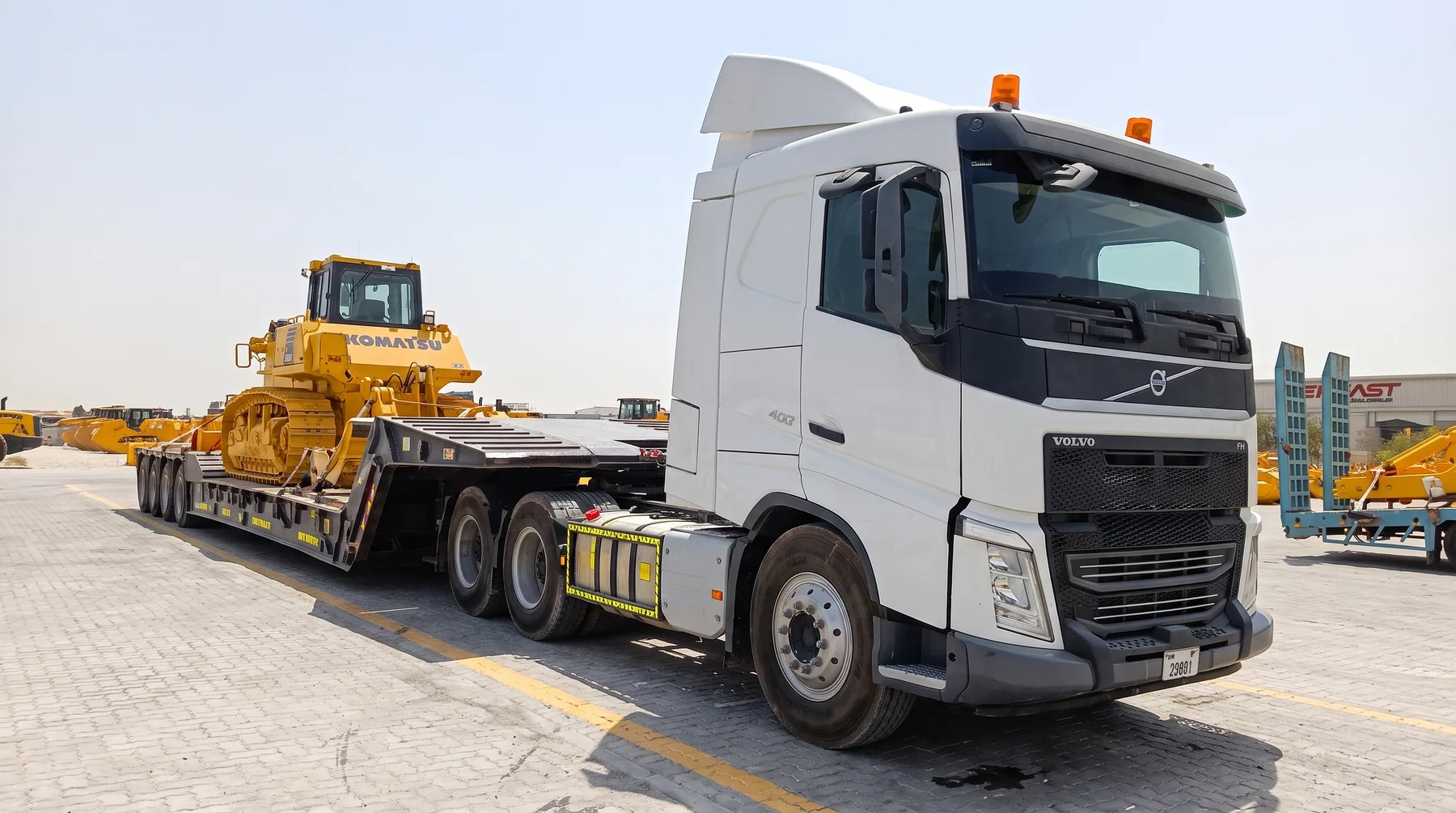
Project cargo transport in the UAE covers oversized, indivisible loads — pressure vessels, reactors, heat exchangers and pre-assembled modules — that exceed a standard 4-axle lowbed’s ~80-tonne band. For these, Decent Way moves loads on multi-axle lowbeds, and arranges SPMT (self-propelled modular transporter) and modular configurations for 100-tonne-plus pieces, backed by a route survey, permits and escorts planned to ADNOC HSE standards.
Approved, cleared & compliant


What counts as project cargo?
Project cargo is any oversized or indivisible load that cannot be broken down and does not fit a standard trailer — so it needs engineered handling rather than a routine flatbed run. In oil, gas and petrochemical work that usually means large fabricated items moving from a fabrication yard or port to a plant or field site.
These loads share two traits: they are heavy (often well past the ~80-tonne band of a 4-axle lowbed) and they are awkward — over-height, over-width, over-length, or all three. That combination is what pulls in route surveys, permits, escorts and, at the top end, SPMT or modular transport.
- Pressure vessels, columns and reactors
- Heat exchangers, drums and separators
- Pre-assembled modules, skids and pipe racks
- Storage-tank sections and structural steel
- Transformers and large rotating equipment
When do you move past a 4-axle lowbed?
You move past a 4-axle lowbed when the load’s weight or footprint exceeds what that trailer can legally and safely carry — broadly once you push beyond the ~80-tonne mark or the deck length. Below that, our fleet handles most jobs directly; above it, the move is arranged on heavier multi-axle or self-propelled equipment.
Our fleet covers the large majority of heavy moves in Abu Dhabi. For genuine project pieces — 100 tonnes and up, or exceptionally long or wide items — SPMT and modular configurations are brought in by arrangement, engineered to the specific load rather than pulled from a fixed catalogue.
- Flatbeds 40–60 ft — general and long cargo
- 3-axle lowbeds ~40–60 t — plant and equipment
- 4-axle lowbeds ~80 t — heavier single pieces
- 100 t+ / SPMT / modular — engineered, by arrangement
Related: Lowbed trailer transport Which trailer & how many axles
What is SPMT and modular transport?
SPMT stands for self-propelled modular transporter — a computer-steered platform of axle lines that carries very heavy or bulky loads and can be coupled together in modules to match weight and length. Because each axle line is powered and steerable, an SPMT spreads load across many wheels and manoeuvres precisely, which is why it is the standard tool for 100-tonne-plus vessels and pre-assembled modules.
Modular transport is the same principle scaled: axle lines and beams are combined to build a trailer to the exact load. Decent Way arranges SPMT and modular spreads by arrangement for qualifying project moves, so the configuration is engineered to your piece — its weight, centre of gravity and loading points — rather than forced onto a fixed trailer.
Why does every project move start with a route survey?
A route survey is the physical check of the whole journey before anything is loaded, and it is the single most important step in a project move because it decides whether the load can actually reach the site. For an oversized piece, the wrong turn or a low bridge is not a delay — it is a stop.
The survey measures clearances and geometry along the exact path: overhead bridges and gantries, roundabout and junction swept paths, road width and camber, and any pinch points at plant or field gates. On field routes from our Musaffah base — Habshan at 150 km, ASAB at 210, Ruwais at 240 — that also means confirming access windows and CICPA gate documentation before the truck rolls.
- Overhead clearances — bridges, gantries, pipe crossings, cables
- Swept paths — roundabouts, tight junctions, gate turns
- Road capacity — width, camber, surface and any weak culverts
- Access windows — timing, CICPA documentation, gate handling
Related: Musaffah to Ruwais heavy transport route Transport to Habshan & Bab
What permits and escorts does an oversized load need?
Oversized and heavy loads need movement permits from the relevant road and police authorities, and — depending on size — police or pilot-car escorts and a defined travel window. Under UAE regulations, loads that exceed standard dimension or weight limits cannot simply drive on demand; they move on approved routes at approved times, typically off-peak or at night.
Decent Way handles this as part of the move: securing the permits, arranging escorts where the load class requires them, and scheduling travel into the windows the authorities allow. For hazmat project cargo, Civil Defence (ADR) requirements and approved-route rules apply on top, and our ADR-permitted crews are set up for that.
Related: Oversize load permits & escorts Dangerous goods transport rules (ADR)
How does Decent Way keep in-field project moves compliant?
In-field compliance rests on credentials that let our trucks and drivers work inside secured oil and gas sites without friction. As an ADNOC-approved supplier, Decent Way runs CICPA-cleared drivers and vehicles, ADSD-certified heavy-vehicle drivers, and IVMS GPS on every truck — so access, driver qualification and tracking are already in place before a project move begins.
Operations run 24/7 across day and night shifts, which matters because oversized loads often travel on night windows. Planning and route surveys, permits and escorts are coordinated to ADNOC HSE standards, and where certification is required it is issued by ADNOC-approved third-party bodies. Our fleet is locally based in Musaffah, which supports clients’ ICV score; ICV certification is in progress.
What should you send to plan a project move?
The more precisely you describe the piece, the faster and more accurate the plan. For project cargo we need the load’s weight and full dimensions, its loading and lifting points, and the pickup and destination — including whether the site is CICPA-restricted.
With those details we can confirm the right trailer or arrange the SPMT/modular spread, scope the route survey, and flag the permits and escorts the move will need. Send it through the quote form, and our team will come back — usually within 2 business hours — with a clear plan and next steps.
- Weight and full dimensions (L × W × H)
- Loading, lifting and lashing points
- Pickup and destination — and CICPA status
- Any hazmat classification (ADR)
- Target dates or plant shutdown window
Plan your project move with Decent Way
For vessels, reactors, modules and other 100-tonne-plus project cargo across Abu Dhabi and the wider UAE, Decent Way pairs a multi-axle fleet with SPMT and modular transport arranged to the load — planned around a proper route survey, permits and escorts to ADNOC HSE standards.
Send your load details through the quote form, call +971 58 227 4083, or reach us on WhatsApp. Quotes are answered within 2 business hours, and operations run 24/7.
Frequently asked questions
Can Decent Way move loads over 100 tonnes?
Yes — for 100-tonne-plus pieces and exceptionally large project cargo, Decent Way arranges SPMT (self-propelled modular transporter) and modular transport by arrangement, engineered to the specific load. Our fleet of flatbeds and 3- and 4-axle lowbeds (up to about 80 tonnes) handles the majority of heavy moves directly.
What is the difference between a lowbed and SPMT?
A lowbed (lowboy) is a towed trailer with a low deck for heavy machinery and single pieces up to roughly 80 tonnes on a 4-axle unit. An SPMT is a self-propelled, computer-steered platform of axle lines that carries far heavier or bulkier loads and can be joined together in modules — the right choice once a piece passes what a lowbed can safely carry.
Do you handle the permits and escorts for oversized loads?
Yes. Decent Way secures the movement permits from the relevant authorities, arranges police or pilot-car escorts where the load class requires them, and schedules travel into the approved windows — often off-peak or at night under UAE regulations. Hazmat project cargo is handled by our Civil Defence (ADR)-permitted crews.
Why is a route survey needed before the move?
A route survey checks the whole journey — overhead clearances, roundabout and junction swept paths, road width and any pinch points at plant or field gates — before anything is loaded. For an oversized load a low bridge or tight turn is a hard stop, so confirming the path in advance is what keeps the move safe and on schedule.
Can you deliver project cargo to remote field sites like Ruwais or ASAB?
Yes. From our Musaffah base we serve Abu Dhabi field sites including Ruwais (240 km), ASAB (210 km), Habshan (150 km), Bu Hasa (190 km) and Shah (270 km). Our drivers and vehicles are CICPA-cleared for secured sites, IVMS-tracked, and coordinated to ADNOC HSE standards.
What details do you need to quote a project move?
Send the load’s weight and full dimensions, its loading and lifting points, the pickup and destination (and whether the site is CICPA-restricted), any ADR hazmat class, and your target dates. With those we confirm the trailer or arrange the SPMT/modular spread, scope the route survey, and reply — usually within 2 business hours.